Two creators wake up on a Monday morning. Both have the same idea for a post about remote work burnout. Creator A writes the post, formats it for LinkedIn, publishes it, then opens X and rewrites it as a thread, then opens Threads and adjusts it again, then Bluesky, then Mastodon. Two hours later, the post is live on five platforms. Creator A is exhausted and has not started actual work yet.
Creator B writes the post once, selects five platforms, adjusts the tone with a few clicks, schedules it for optimal times on each platform, and sets an auto-repost rule for anything that crosses 50 likes. Twelve minutes. Done. Then Creator B goes to work.
Both creators published the same idea to the same platforms. One spent two hours. The other spent twelve minutes. By the end of the month, the time gap compounds into hundreds of hours. Creator A burns out. Creator B publishes twice as much content and works less. The difference is not talent, discipline, or creativity. It is automation.
78% of marketers expect to automate over 25% of their tasks with AI tools by the end of 2026. The ones who have already made that shift report spending 80% less time on content creation while seeing 32% higher engagement. That is not a marginal improvement. That is a structural advantage.
What AI Automation Actually Means for Creators
When people hear "AI automation for content," they picture a robot writing their posts. That is the least interesting application, and honestly, the least useful. The real power of AI automation is not in generating words. It is in eliminating the mechanical work that surrounds the creative work.
Think about everything that happens between having an idea and that idea reaching your audience:
- Writing the initial draft
- Adapting it for different platforms and character limits
- Splitting long-form content into threads
- Choosing the best time to publish on each platform
- Actually publishing across 3-7 platforms
- Monitoring performance
- Reposting content that performs well
- Analyzing what worked and feeding insights back into your strategy
The creative work is the first bullet point. Everything else is logistics. And logistics is exactly what automation handles best.
46% of marketers already find repurposing existing content more effective than creating new content from scratch. AI automation makes that repurposing nearly effortless. You focus on the thinking. The system handles the distribution.
The Automation Stack
A content automation stack is not one tool. It is a set of capabilities that work together to move content from your brain to your audience with minimal manual steps. Here is what each layer does.
Scheduling and Multi-Platform Publishing
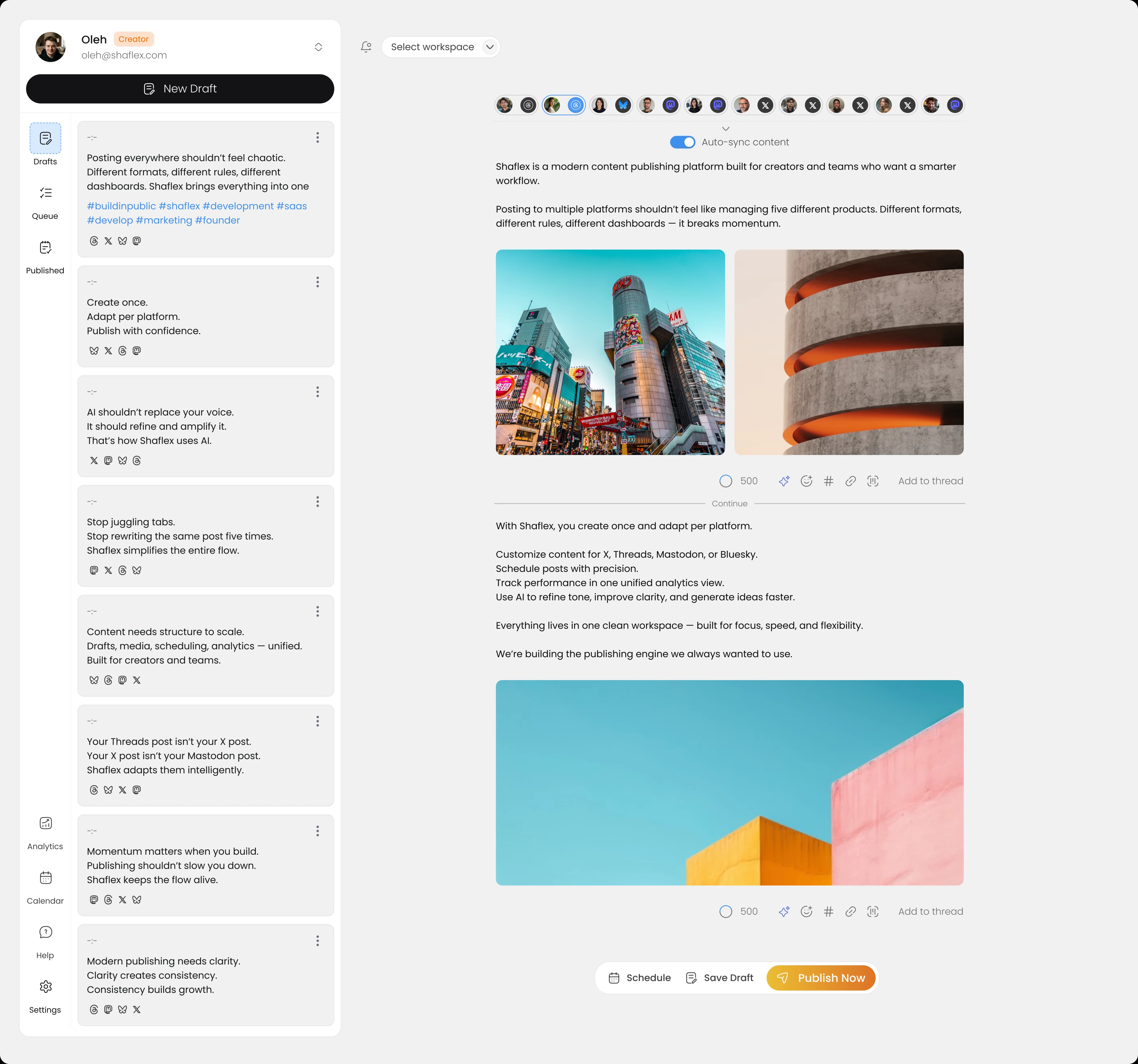
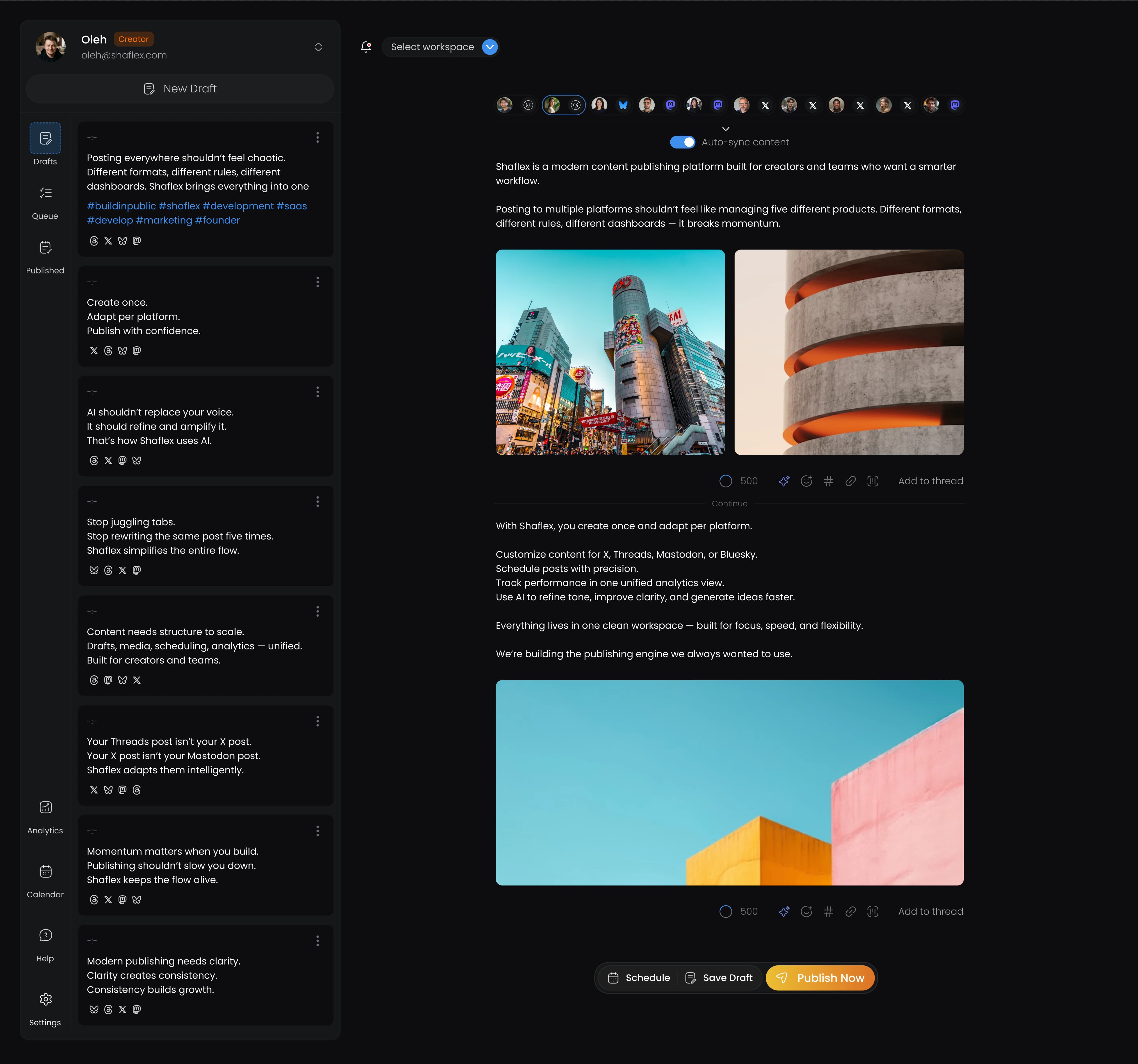
The foundation of any content automation setup is the ability to write once and publish everywhere. A multi-platform composer lets you draft a post, preview how it will look on each platform, make per-platform adjustments, and schedule everything from one screen.
This sounds basic, but the time savings compound. If you post to five platforms daily, manual publishing costs you 30-45 minutes per day just in switching between apps, logging in, formatting, and hitting publish. That is 3-5 hours per week spent on pure logistics.
With a scheduling tool, you batch-create content in a single session and schedule an entire week in advance. The posts go out automatically at the times you set, whether you are asleep, in a meeting, or on vacation.
If you are cross-posting to multiple platforms, this is where the efficiency gains start. But scheduling is just the first layer.
Best Time to Post (AI-Driven)
Posting at 9 AM because someone told you that is the best time for LinkedIn is not a strategy. It is a guess based on an average that may not apply to your audience.
AI-powered posting time recommendations analyze your actual engagement patterns, not generic benchmarks, to determine when your specific audience is most active and most likely to engage. The recommendations adapt as your audience grows and changes. What worked three months ago might not work today if your follower base has shifted geographically or demographically.
This is a good example of automation that is invisible but impactful. You do not notice it working. You just notice that your engagement rates are higher than they should be.
Thread Auto-Splitting
Long-form content performs well on platforms like X, Threads, and Bluesky. But manually splitting a 1,200-word post into a thread of properly sized chunks, with clean breaks and numbered formatting, is tedious work. It is also the kind of work that machines do perfectly.
Thread auto-splitting takes your long-form content and breaks it into platform-appropriate segments. Each segment respects character limits, breaks at natural points, and maintains readability. You write the full thought. The tool handles the formatting.
This matters more than it seems. Creators who skip thread formatting because it is annoying are leaving reach on the table. Threads consistently outperform single posts in engagement and impressions. Automation removes the friction that prevents you from using the format.
Auto Plug: The Amplification Layer
This is where automation gets genuinely interesting. Auto Plug rules let you set conditions that trigger automatic actions based on post performance.
Examples:
- Auto-reply rule: When a post gets more than 20 likes within the first hour, automatically add a comment with a link to your newsletter signup or a related resource. This converts engagement into subscribers while the post is hot.
- Auto-repost rule: When a post crosses 100 likes, automatically repost it 48 hours later to catch the audience segment that missed it the first time.
These rules turn your best-performing content into self-promoting assets. Instead of manually checking analytics and deciding to reshare a post, the system does it for you based on performance thresholds you define.
The beauty of Auto Plug is that it creates a performance-based feedback loop. Your best content automatically gets more distribution, which generates more engagement, which triggers more distribution. It is a flywheel within the flywheel.
Analytics Dashboard: The Feedback Engine
Data without context is noise. An analytics dashboard that consolidates followers, posts, views, likes, comments, and reposts across all your platforms into one view gives you the context you need to make decisions.
Instead of logging into five different platforms and mentally aggregating numbers, you see everything in one place. Which platform is growing fastest? Which content type generates the most comments? Which topics get shared the most?
This feedback engine is what turns a content system into a content flywheel. You see what works, you produce more of it, and you automate the distribution of your best material. Each cycle is faster and more effective than the last, because each cycle starts with better data.
For a deeper dive into which numbers actually matter, read our guide on analytics metrics that matter. The short version: track trends, not individual posts.
Building Your Automated Flywheel
Here is how the pieces fit together into a self-reinforcing system.
Step 1: Create One Core Piece of Content
This is the human part. Sit down with your ideas, your expertise, and your perspective. Write something worth reading. No automation tool can replace this step, and none should.
Spend your creative energy here. Make the argument clear. Add your voice and your experience. This is the raw material that everything else is built on.
Step 2: Multiply Across Platforms
Take your core piece and adapt it for each platform. A long LinkedIn post becomes an X thread. The thread becomes a Threads post. A key quote becomes a standalone Bluesky take. If you are writing in a multi-platform composer, these adaptations happen in the same session, not as separate tasks spread across the day.
Thread auto-splitting handles the formatting. Per-platform previews show you exactly what each version will look like before it goes live.
Step 3: Schedule With Intelligent Timing
Queue each version for the optimal posting time on its respective platform. AI-driven timing recommendations handle the "when" so you can focus on the "what."
Build a buffer. Schedule at least one week ahead so your content publishes even during your busiest days. Two weeks is better. Your consistency should not depend on your availability. For a deep dive into timing strategy, check out our guide on mastering social media scheduling.
Step 4: Set Amplification Rules
Configure Auto Plug rules for your key platforms. A good starting set:
- Auto-reply with a relevant link when engagement crosses a threshold
- Auto-repost high performers after a 48-hour delay
- Auto-reply to posts in specific topic categories with related content from your library
These rules run continuously in the background. You set them once and adjust as you learn what thresholds and actions produce the best results.
Step 5: Review, Learn, Repeat
Every two weeks, open your analytics dashboard. Look at what worked. Look at what did not. Ask specific questions: Which topics drove the most engagement? Which platforms saw the fastest growth? Which Auto Plug rules triggered the most secondary engagement?
Feed those answers back into Step 1. Create more content around your best-performing topics. Adjust your platform mix based on growth data. Refine your amplification thresholds. Each cycle through this loop makes the next cycle more effective.
This is the content flywheel growth engine in practice. Create, distribute, analyze, optimize, repeat. Each rotation is faster and produces more output than the last.
What to Automate vs. What to Keep Human
Automation is powerful, but it has limits. The creators who get the best results from AI tools are deliberate about what they automate and what they keep manual.
Automate These
Distribution mechanics. Scheduling, cross-posting, format adaptation, thread splitting. These are logistics. They require precision and repetition, not creativity.
Timing decisions. When to publish on each platform. AI analysis of your engagement patterns will outperform your intuition here, because it processes more data than you can.
Performance-based actions. Reposting winners, adding engagement replies, recycling evergreen content. These follow clear rules and thresholds that machines execute perfectly.
Analytics aggregation. Pulling data from multiple platforms into one view. This is pure data processing, exactly what computers are for.
Keep These Human
Original thinking. Your ideas, opinions, and perspectives. AI can help you research and brainstorm, but the core insight needs to come from you. That is what your audience follows you for.
Voice and tone. The way you write, the phrases you use, the personality that comes through in your posts. For practical tips on keeping your voice while using AI tools, the principle is simple: AI assists, you decide.
Strategic direction. Which topics to focus on. Which platforms to prioritize. When to pivot your content strategy. These decisions require judgment that comes from understanding your goals, your audience, and your market.
Community engagement. Replies to comments, DMs, and conversations. Automation can prompt you to engage, but the actual human interaction should be genuinely human. Audiences can tell the difference.
Emotional judgment. Whether a post is funny or tone-deaf. Whether a topic is timely or insensitive. Whether your take is bold or offensive. These require emotional intelligence that AI does not have.
The ROI of Automation
The numbers on AI content automation are clear. Marketers report an average 300% ROI on AI tools, with the primary gains coming from time savings and increased output rather than reduced headcount.
Here is what that looks like in practice for a solo creator or small team:
Before automation: 10 hours per week on content creation and distribution. 5 posts per week across 2 platforms. Inconsistent scheduling. No performance-based amplification. Monthly review of analytics (if you get to it).
After automation: 4 hours per week on content creation. 5 posts per week across 5 platforms, automatically scheduled and formatted. Auto Plug rules amplifying top performers. Biweekly analytics review taking 30 minutes instead of two hours.
Same creative effort. 2.5x the distribution. Consistent execution. Continuous optimization. And six extra hours per week that you can spend on the creative thinking that AI cannot replace.
The flywheel is not a metaphor. It is a mechanical description of how consistent, automated content distribution compounds over time. Each post feeds the next. Each cycle is more efficient than the last. The creators who build this machine in 2026 will have a structural advantage that manual operators cannot match, no matter how talented or hardworking they are.
The creative work still belongs to you. Everything else can run on its own. If you are ready to see how consistent posting compounds over time, automation is what makes that consistency sustainable.


 Apr 21, 2026