"Post three times a week on LinkedIn." You wrote that goal down in January. It is April now. How is it going?
If you are like most founders and creators, the answer is somewhere between "inconsistently" and "I stopped in February." That is not a failure of willpower. It is a failure of architecture. You set a content goal without building a content system, and goals without systems have a predictable failure rate that approaches 100%.
There is a principle we keep coming back to: "You do not rise to the level of your goals. You fall to the level of your systems." That line applies to fitness, finance, and business. It applies to content creation with equal force. The difference between wanting to post consistently and actually posting consistently is not motivation or discipline. It is infrastructure.
Why Content Goals Fail
Content goals fail for the same reason most goals fail: they describe an outcome without prescribing a process.
The Motivation Trap
"Post 3x per week" sounds reasonable on a Monday morning when you are caffeinated and optimistic. By Wednesday afternoon, when you are buried in client work and have not written anything, the goal feels impossible. You skip Wednesday's post. You tell yourself you will make it up on Thursday. You do not. By Friday, you have missed the week, and the guilt compounds until posting feels like a chore rather than a strategy.
This cycle repeats until the goal quietly dies. It was never sustainable because it depended on a resource that fluctuates daily: your motivation and available energy.
The Decision Fatigue Problem
Every time you sit down to create content without a system, you face a cascade of decisions. What should I write about? Which platform should I post to? What format should I use? Should I include an image? When should I publish?
Each decision drains cognitive energy. By the time you have answered all of them, you have less mental bandwidth for the actual writing. Multiply this by three posts per week across multiple platforms, and you are spending more energy deciding what to do than doing it.
The Quality Spiral
Without a system, every post carries enormous psychological weight. If you are only posting three times this week, each post has to be good. That pressure leads to overthinking, which leads to longer creation times, which leads to missed deadlines, which leads to posting less, which makes each remaining post carry even more weight. It is a self-reinforcing spiral that ends with not posting at all.
The Anatomy of a Content System
A content system is not a content calendar. A content calendar is a template that tells you what to post when. A system is the entire infrastructure that turns raw ideas into published content with minimal friction. The calendar is one component. The system includes everything else.
Component 1: The Input Engine
Every content system needs a reliable source of raw material. This is your input engine, the mechanism that captures ideas before they disappear.
Practical implementation: carry a capture tool everywhere. A notes app, a voice recorder, a dedicated Slack channel where you send yourself ideas. The format does not matter. What matters is that when you have a thought worth sharing, it goes somewhere retrievable within five seconds.
Most creators lose dozens of content ideas per week because they think "I'll remember that" and then do not. A capture system with zero friction eliminates that leak.
Set a weekly target for captured ideas. Fifteen to twenty raw ideas per week gives you plenty of material to work with. These do not need to be fully formed. A sentence, a question, a screenshot, a quote, anything that could become a post.
Component 2: The Processing Pipeline
Raw ideas need to be processed into publishable content. This is where most creators get stuck, because they try to go from idea to finished post in one step.
Break it into stages:
Stage 1: Triage. Once a week, review your captured ideas. Sort them into three buckets: ready to develop, needs research, and discard. Be ruthless with the discard pile. Not every idea is worth a post.
Stage 2: Outline. Take 5-7 ideas from the "ready to develop" bucket and write a one-paragraph outline for each. What is the core argument? What is the hook? What is the takeaway? This takes 20-30 minutes for the whole batch.
Stage 3: Draft. Write the full posts. If you batch this, you can draft 5-7 posts in a single focused session of 90 minutes to two hours. Do not edit while you draft. Get the ideas down. Editing is a separate stage.
Stage 4: Edit and format. Polish the drafts. Adjust for each platform's format and character limits. Add formatting, mentions, hashtags. This is also where you create variations for cross-posting.
Stage 5: Schedule. Queue everything up. Assign publish dates and times. Once this step is done, your content runs on autopilot until the next batch.
Component 3: The Distribution Layer
Creating content is half the job. Distributing it is the other half, and most creators treat it as an afterthought.
A distribution layer answers these questions systematically:
- Which platforms does each post go to?
- What adjustments are needed for each platform's format?
- When does each version publish?
- What happens after a post performs well? (Repost? Boost? Expand into a longer piece?)
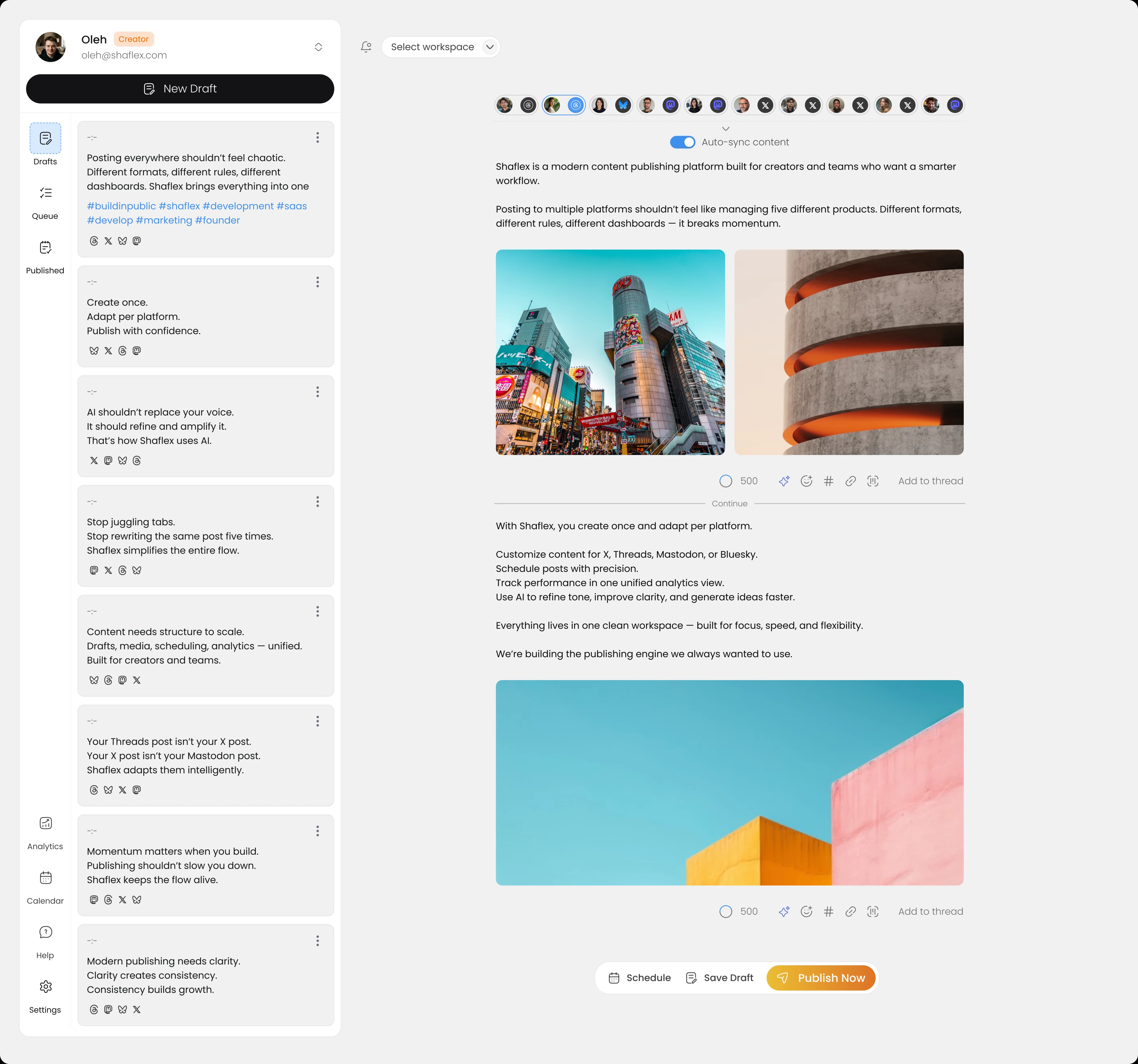
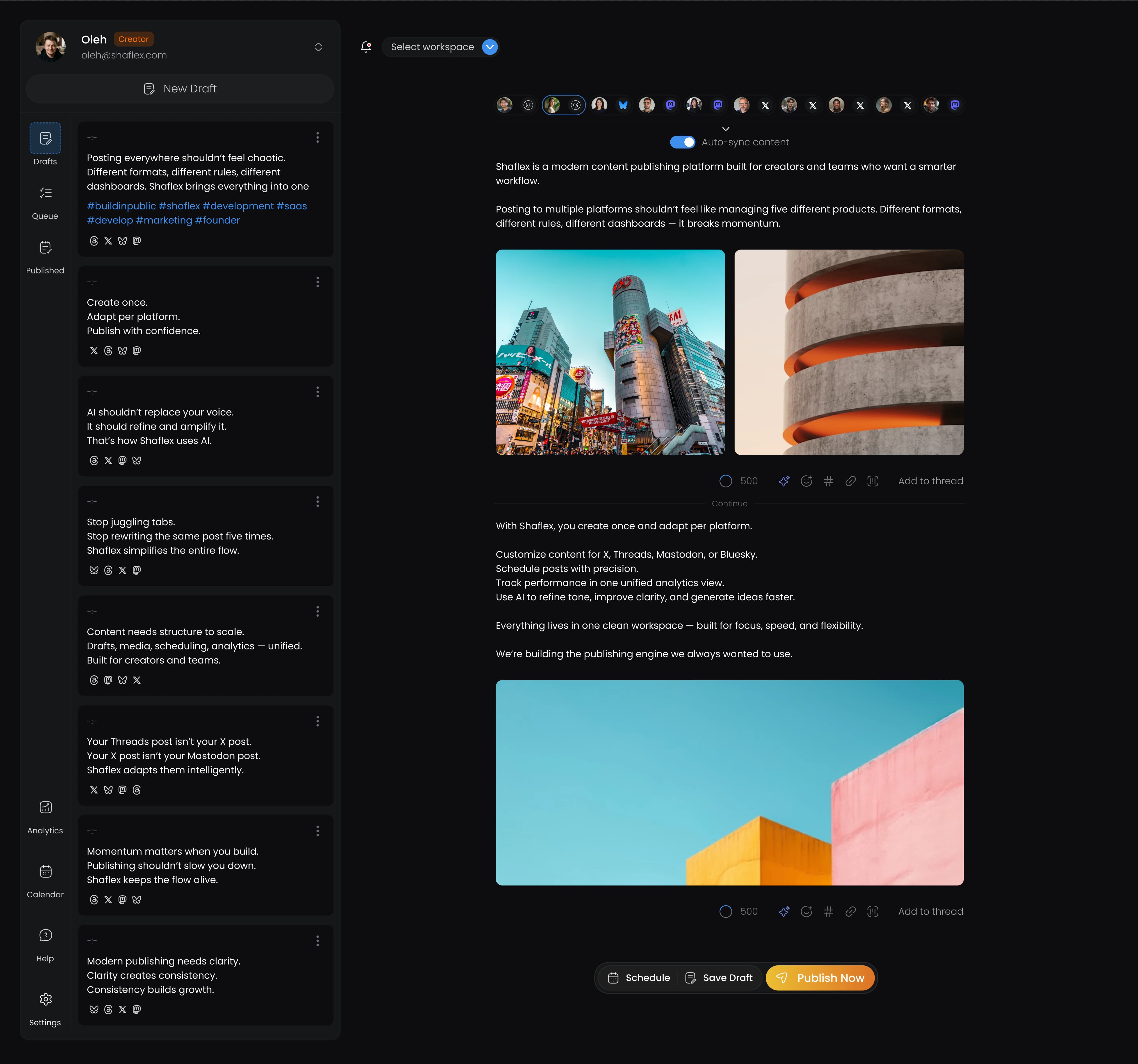
The goal is to turn one piece of content into multiple touchpoints across multiple platforms without manual copy-paste work each time. Thread auto-splitting, multi-platform scheduling, and format adaptation are not luxuries. They are core infrastructure.
Component 4: The Feedback Loop
A system without feedback is a system that never improves. Your feedback loop connects your analytics back to your input engine.
Every two weeks, review your content performance. Which posts got the most engagement? Which topics resonated? Which formats worked? Feed those insights back into your idea capture and processing stages. Double down on what works. Retire what does not.
This is what turns a static system into a content flywheel, a self-reinforcing loop where each cycle produces better results than the last.
From Calendar to Flywheel
Most people start with a content calendar and stop there. A calendar is a scheduling tool. It tells you "post about X on Tuesday." That is useful, but it is only one layer.
The progression looks like this:
Level 1: The Calendar
You have a spreadsheet or tool that maps content to dates. You know what is going out and when. This solves the "what should I post today?" problem but does nothing for the "how do I create it efficiently?" problem.
Level 2: The Workflow
You add a creation process to the calendar. Batch creation sessions. Templates for recurring content types. A library of hooks and formats you can remix. This solves the efficiency problem. You produce more content in less time.
Level 3: The System
You add distribution automation and analytics feedback. Content flows from creation to scheduling to publishing to analysis without manual intervention at each step. You spend your time on the creative work and let the system handle the logistics.
Level 4: The Flywheel
You add compounding mechanics. High-performing content gets automatically repurposed and redistributed. Audience growth increases the reach of every subsequent post. Your content library becomes an asset that appreciates over time rather than a pile of posts that expire after 24 hours.
At Level 4, the system generates momentum on its own. You still feed it ideas and creative energy, but the mechanical work of distribution, optimization, and recycling happens without you. This is what separates systems thinkers from goal setters in the content space.
Measuring Your System, Not Your Output
Here is a counterintuitive shift: stop measuring how much content you produce. Start measuring how well your system operates.
System Health Metrics
Input rate: How many raw ideas enter your capture system per week? If this number drops, your input engine needs attention. You might need new sources of inspiration, different media consumption habits, or more conversations with your audience.
Processing throughput: What percentage of captured ideas become published posts? A healthy system converts 30-50% of raw ideas into content. Below 20%, your processing pipeline has a bottleneck. Above 60%, you might not be capturing enough ideas.
Distribution multiplier: How many platform-posts does each core piece generate? If one idea becomes one post on one platform, your distribution layer is underperforming. Target 3-5x multiplication at minimum.
Feedback cycle time: How quickly do performance insights loop back into your content decisions? If you are reviewing analytics quarterly, that is too slow. Biweekly keeps the feedback loop tight enough to adapt.
Why System Metrics Beat Output Metrics
Counting posts published is a vanity metric. You can publish 30 posts in a month that reach nobody. The system metrics tell you whether your machine is functioning, not just whether it is running.
A system that captures 20 ideas per week, converts 35% into content, distributes each piece to 4 platforms, and reviews performance biweekly will produce consistent, improving results regardless of what any individual post does. You are measuring the engine, not the exhaust.
Building Your System in One Week
You do not need months to build a content system. You need one focused week.
Day 1: Set up your capture tool. Choose one place where all content ideas go. Pin it to your home screen. Make it frictionless.
Day 2: Design your processing pipeline. Map out the stages from idea to published post. Decide when each stage happens during your week. Block the time on your calendar.
Day 3: Establish your distribution layer. Choose your platforms. Set up your scheduling tool. Create templates for how each content type adapts to each platform.
Day 4: Build your first batch. Capture 15 ideas. Process 7 of them through your pipeline. Schedule a full week of content across your platforms.
Day 5: Set up your feedback loop. Decide which metrics you will track. Schedule a biweekly review. Create a simple tracking document.
Days 6-7: Buffer. Use the weekend to capture more ideas and build a two-week content backlog. The buffer is what keeps your system running when a busy week hits.
By the end of one week, you have a functioning content system. It will be rough. It will need adjustment. But it will produce content automatically, which is more than any goal has ever done on its own.
The System Runs Even When You Do Not
The ultimate test of a content system is what happens on your worst day. When you are sick, overwhelmed, traveling, or simply not feeling creative. A goal fails on those days. A system does not, because it was designed to operate with minimal active input.
Your content backlog publishes on schedule. Your distribution rules send content to the right platforms. Your analytics collect data for your next review. The flywheel keeps spinning because you built it to spin, not because you are standing there pushing it every morning. This is what a publishing system that works on your worst days actually looks like in practice.
That is the difference between a content goal and a content system. One depends on you showing up with energy and motivation every single day. The other depends on architecture, and architecture does not have bad days.


 Apr 22, 2026