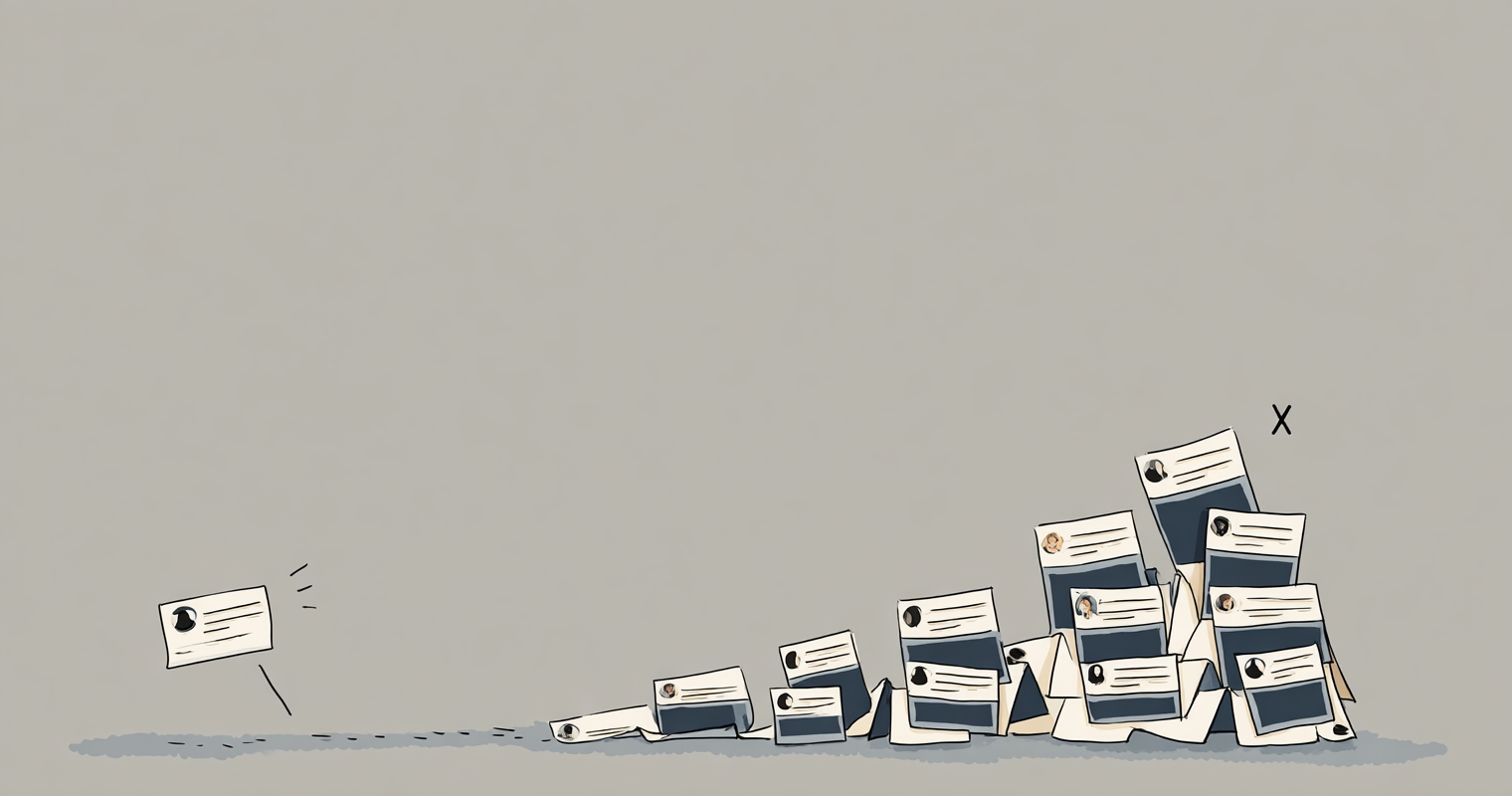
One high-volume content creator posted 35,000 pieces of content in 2025 and pulled in 32.7 million YouTube views in a single month. The conclusion was blunt: "It's far more linear than you would expect. We're doing 100x the volume, we get 100x the prospects." If you are posting once a day and wondering why growth has stalled, social media posting frequency is probably the first variable you should examine. Not your hooks. Not your hashtags. Not your posting time. The volume itself.
Most solo founders publish one post per day to one platform. That is 365 pieces of content per year. That creator's team produced nearly 100 times that number. The gap between those two outputs is not a talent gap or a creativity gap. It is a repurposing gap, and closing it does not require a 20-person media team.
This article breaks down the relationship between posting volume and results, shows you exactly how often to post on social media in 2026, and gives you a repeatable system so you can increase output without working more hours.
What does the data actually say about social media posting frequency?
The conventional wisdom says post once a day, stay consistent, and the algorithm will reward you. That advice was reasonable in 2019. It is incomplete in 2026.
Here is what the numbers say. That content operation tracked a near-linear relationship between volume and outcomes. Double the posts, roughly double the reach. Triple the posts, roughly triple the leads. This held true across YouTube, X, Instagram, LinkedIn, and podcasting.
On the other end of the spectrum, Buffer analyzed engagement rates across thousands of accounts and found that engagement per post drops about 40% after the fifth post per week on a single platform. That sounds like a contradiction until you read it carefully. The drop is per post, not total. Five posts at 60% engagement each still produce more total engagement than one post at 100%.
The takeaway: posting more frequently to more platforms generates more total results, even if each individual post gets slightly less attention. The math favors volume, as long as quality does not collapse.
For a solo founder, the practical question is not "should I post more?" It is "how do I post more without spending my entire day on content?"
Why does posting once a day keep you invisible?
One post per day on one platform means 365 pieces of content per year. That sounds productive until you consider the math of reach.
Most social platforms show your post to 5-15% of your followers organically. If you have 2,000 followers and post once, roughly 200 people see it. Many of those people scroll past it. Of the ones who stop, a fraction engage. Of the ones who engage, a smaller fraction click, follow, or buy.
Now multiply that single post across five platforms. Same content, adjusted for character limits and formatting. That is 1,000 potential impressions instead of 200, from the same writing session.
The problem with posting once a day is not that your content is bad. The problem is that the math of distribution works against you. Every platform is a slot machine. Each post is a pull. One pull per day gives you one chance to hit. Ten pulls per day across multiple platforms gives you ten.
That creator did not get to 32.7 million views because every piece was a masterpiece. The volume created enough surface area for the algorithm to find winners, and those winners pulled the rest of the content up.
How do you turn one idea into ten posts?
Content repurposing is the bridge between posting once and posting ten times without working ten times harder. Here is the exact framework.
Start with one core idea each day. Write it as a full post for your primary platform, probably LinkedIn or X. Spend your best creative energy here. Then multiply it.
1. The original post. Your full-length piece. 150-300 words on LinkedIn, or a detailed X post. This is where you develop the argument.
2. The short version. Cut it to 280 characters for X or 300 for Bluesky. Keep the hook and the conclusion, remove the middle.
3. The thread version. Expand the idea into 3-5 connected posts. Threads work well on X, Threads, and Bluesky because they get algorithmic preference over single posts.
4. The cross-post. Publish the original to all your platforms with character limits adjusted. If you are doing this manually, it takes 20 minutes. If you use a tool that handles cross-posting to multiple platforms, it takes one click.
5. The reply. Post a follow-up comment on your own post with additional context or a question. Self-replies boost engagement on most platforms because they signal active conversation.
6. The pull quote. Take one sentence from your post and publish it standalone. The best candidates are sentences that are surprising, contrarian, or data-driven.
7. The question flip. Turn your statement into a question. "Scheduling does not hurt your reach" becomes "Does scheduling actually hurt your reach?" That question format drives comments.
8. The data point. If your original post contained a number, make that number its own post. "32.7 million views from 35,000 posts" works as a standalone piece.
9. The contrarian take. Argue the opposite side of your original post. People engage with debate. If your original said "post more often," the contrarian version says "here is when posting less actually works better."
10. The micro-story. Tell a 3-sentence personal story that illustrates the same core point in a different way. Stories outperform advice posts on nearly every platform.
One idea. Ten posts. Five platforms. That is 50 pieces of content from one morning of focused writing. Over a month, that is 1,500 posts. Over a year, 18,000. You are now in the same order of magnitude as that high-volume strategy, without a media team.
What is the SPCL framework for high-volume posting?
Volume without direction is noise. The SPCL framework ensures that every post serves a strategic purpose. If you are going to increase your posting volume strategy, you need a filter that keeps quality high even as quantity scales.
Status. Show that you control something valuable. Revenue numbers, customer count, results you have produced for clients, growth metrics. Status posts signal authority. Example: "We crossed 10,000 users this month. Here is the one thing we changed in March."
Power. Give directions that lead to good outcomes. Tactical advice that someone can follow and get results from. If a follower uses your tip and it works, they will come back for more. Example: "Stop posting at 9 AM. Post at 6 PM instead. Here is why your timezone strategy matters for engagement."
Credibility. Third-party proof. Awards, press features, customer testimonials, data from your own experiments. Credibility posts build trust without you having to explicitly ask for it. Example: "A customer told us they saved 4 hours per week by switching to scheduled cross-posting. Here is their exact workflow."
Likeness. The personal details that make you different from every other account in your niche. Your background, your quirks, your opinions. Likeness is what turns followers into fans. Example: "I built this product because I was tired of logging into five apps every morning just to post the same thing."
Every post you create should check at least one of these four boxes. The best posts check two or three. When you are generating ten posts from one idea, tag each variation with its SPCL category. This prevents you from accidentally publishing ten status posts in a row or ten advice posts with no personal connection.
How often should you post on each platform in 2026?
The right frequency depends on where you are posting. Here is what works in 2026 based on current algorithm behavior and engagement data.
X (Twitter). 3-5 posts per day minimum. X rewards recency heavily. Posts have a short shelf life, often under 30 minutes for most accounts. Threads get extended visibility. Replies to your own posts count toward engagement metrics.
LinkedIn. 1-2 posts per day. LinkedIn's algorithm gives each post a longer window, typically 24-48 hours. Posting more than twice tends to cannibalize your own reach. Focus on quality here and use other platforms for volume.
Threads. 2-4 posts per day. Threads is still growing its algorithm, and frequent posters are getting disproportionate visibility. This is a good platform for repurposed short-form content.
Bluesky. 2-3 posts per day. Similar dynamics to early Twitter. Chronological feeds mean recency matters. Post more often in shorter bursts rather than batching.
Mastodon. 1-2 posts per day. The culture on Mastodon is different. High-volume posting can actually hurt your reputation in some communities. Focus on thoughtful posts here.
The total across all five platforms: 9-16 posts per day. That sounds like a full-time job until you realize that most of those posts are variations of a single idea, distributed through a scheduling tool that handles the timing and formatting.
When do more posts stop helping?
More is not always better. There is a point where additional posts produce diminishing returns, and pushing past it wastes time you could spend on other growth activities.
Buffer's data shows that engagement per post drops significantly after the fifth post per week on a single platform. The drop is not catastrophic, roughly 40%, but it means your sixth and seventh posts each week are working harder for less return.
The practical ceiling for most solo founders is 3-5 original ideas per day, each repurposed across platforms. Going beyond that typically requires either a content team or a drop in quality that hurts your brand more than the extra volume helps.
Here are the warning signs that you have hit your frequency ceiling:
Engagement rate drops below your baseline. If your average post gets 50 likes and your recent posts are getting 20, you may be oversaturating your audience.
You start repeating yourself without adding new angles. Repurposing is about presenting the same idea in different formats. If you are posting the same sentence to the same platform three times a week, that is not repurposing. That is spam.
Content quality visibly declines. If you are rushing through posts just to hit a quota, your audience will notice. One strong post beats five weak ones.
You are burning out. Sustainable output matters more than peak output. A posting volume strategy that you abandon after three weeks is worse than a moderate one you maintain for a year.
The sweet spot for most founders: 1-3 core ideas per day, each turned into 3-5 variations, distributed across 3-5 platforms. That puts you in the range of 10-25 posts per day total, which is enough volume to see compounding growth without destroying your schedule.
How does scheduling make high posting volume sustainable?
You cannot manually log into five platforms and post three times a day to each one. That is 15 individual sessions, 15 character limit adjustments, 15 publish buttons. Nobody has time for that.
This is where scheduling changes the game. Instead of posting in real time, you batch your content creation into one focused session. Write your core ideas in the morning. Generate your variations. Load them into a scheduler. Let the tool handle distribution throughout the day and week.
The people posting at high volume in 2026 are not spending more time on social media. They are spending the same amount of time, sometimes less, and publishing more because their tools handle the distribution layer.
There is a common concern that scheduling hurts reach. The data does not support this. Platforms cannot reliably detect whether a post was published manually or through a scheduling tool, and engagement rates are statistically identical. If you are skeptical, read the full breakdown on whether scheduling posts hurts reach.
A good scheduling workflow looks like this:
- Block 60-90 minutes each morning for content creation.
- Write 1-3 core ideas.
- Generate variations using the ten-post framework above.
- Load everything into your scheduler with platform-specific formatting.
- Review your content calendar weekly to ensure variety across SPCL categories.
- Spend 15-20 minutes per day on live engagement: replies, comments, conversations.
That is under two hours per day for 15-25 posts across five platforms. Compare that to the alternative: logging in and out of apps, manually adjusting character counts, forgetting to post because you got pulled into a meeting.
How do you ramp up posting volume in 30 days without burning out?
Do not go from one post per day to twenty-five overnight. You will burn out by day four. Instead, ramp up gradually over 30 days.
Week 1: Baseline. Post one original idea per day. Cross-post it to all your platforms without modification. This gets you from 1 post per day to 5 with zero extra creative work. Your only new habit is using a cross-posting tool.
Week 2: Add one variation. For each original post, create one short version or one thread version. You are now at 10 posts per day: 5 originals and 5 variations.
Week 3: Add the reply. After each original post goes live, add a self-reply with additional context. This is the lowest-effort way to boost engagement on existing content. You are now at 15 posts per day.
Week 4: Full framework. Pick your best-performing core idea each day and run it through the complete ten-post framework. Use the SPCL filter to ensure variety. You are now at 20-25 posts per day.
By the end of the month, you will have posted 400-500 pieces of content. That is more than most founders post in an entire year. And because you ramped up gradually, you built the muscle memory and systems to sustain it.
Track your results weekly. Look at total impressions, total engagement, follower growth rate, and inbound messages. The relationship between volume and results should become visible by week three.
What This Looks Like in Practice
Let me walk through a concrete day using this system.
You sit down at 8 AM with coffee. Today's core idea: "Most founders underestimate how long it takes to see results from social media."
8:00-8:20. Write the full LinkedIn post. 200 words. Include a personal anecdote about your first six months of posting with no traction. Tag it as Likeness + Power in the SPCL framework.
8:20-8:30. Write the short version for X and Bluesky. "I posted for 6 months with zero results. Month 7 is when everything changed. The problem was never the content."
8:30-8:45. Write a 4-part thread version. Post 1: the hook. Post 2: the struggle. Post 3: what changed. Post 4: the lesson with a specific number.
8:45-8:55. Create the question flip version: "How long did it take before social media actually started working for your business?"
8:55-9:00. Pull out the data point: "It takes an average of 90 days of consistent posting before most accounts see meaningful traction."
9:00-9:10. Load all variations into your scheduler. Set LinkedIn for 9 AM. X posts staggered at 10 AM, 1 PM, and 5 PM. Threads at 11 AM. Bluesky at noon. Mastodon at 2 PM.
9:10-9:15. Write self-replies for the LinkedIn and X posts. Add them to the scheduler timed for 30 minutes after the original goes live.
Total time: 75 minutes. Total posts scheduled: 15-20 across five platforms. Tomorrow, you do it again with a different idea.
Why does consistent posting volume compound over time?
The reason this works is not because any single post goes viral. It works because of compounding.
Each post has a small probability of reaching new people. More posts means more chances. Over weeks and months, those chances stack up. Your best posts get shared. New followers see your back catalog. The algorithm starts recommending your content to people outside your network.
That creator did not become a social media giant overnight. The growth came through relentless, systematic output over months. The 35,000 posts were not 35,000 flashes of genius. They were 35,000 iterations on a small number of core ideas, presented in different formats, distributed across every available channel.
You do not need 35,000 posts. You need enough volume to trigger the compounding effect, which for most accounts starts around 10-15 posts per day across platforms, sustained for 90 days or more.
The founders who are growing their audiences in 2026 are not the ones with the best ideas. They are the ones with the best systems for turning one idea into ten posts and getting those posts in front of people on every platform where their audience spends time.
Start Posting More Today
You now have the framework: one idea becomes ten posts across five platforms. You have the SPCL filter to maintain quality. You have the 30-day ramp to build the habit without burning out. The only missing piece is a tool that makes the distribution fast enough to be sustainable.
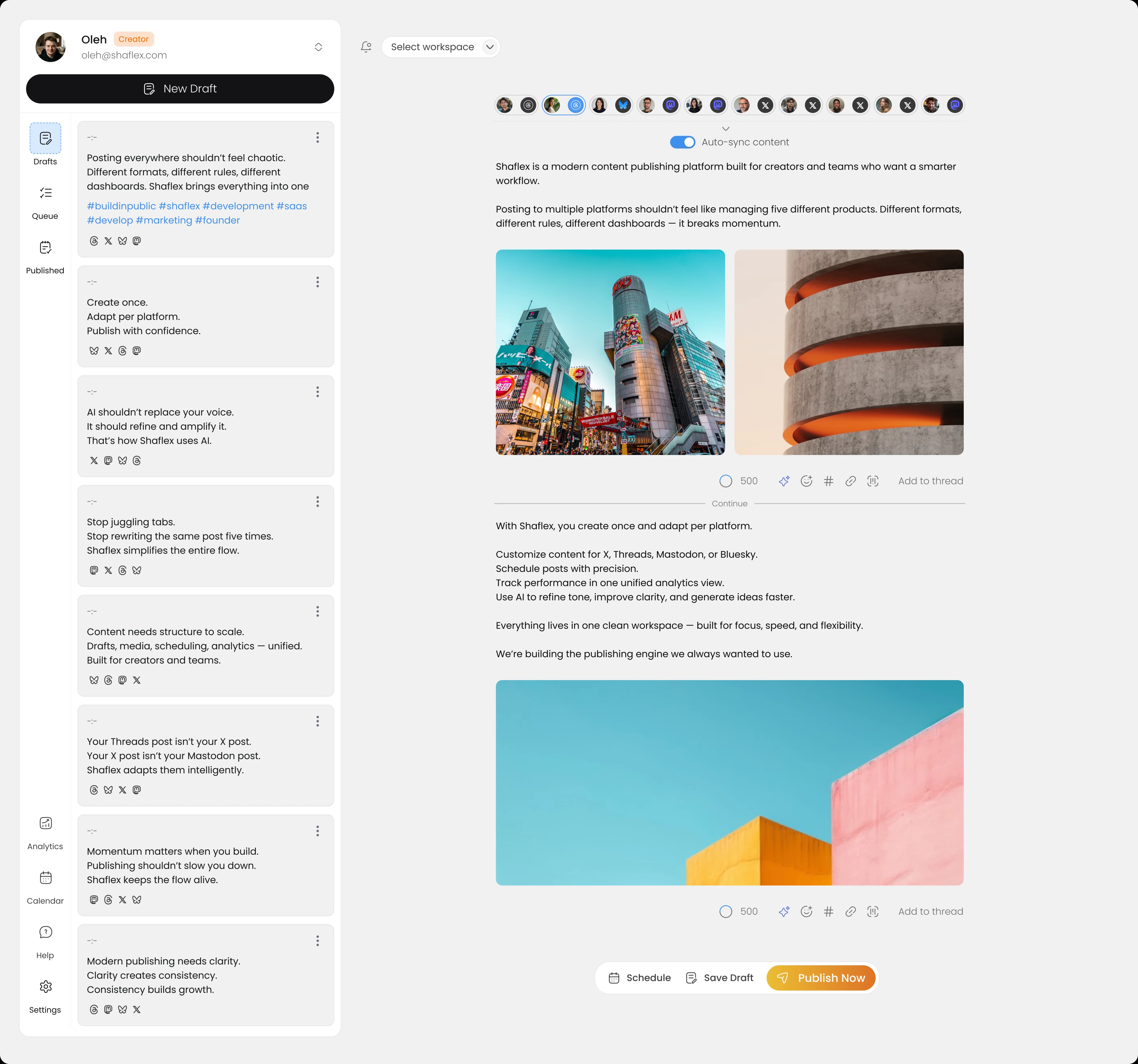
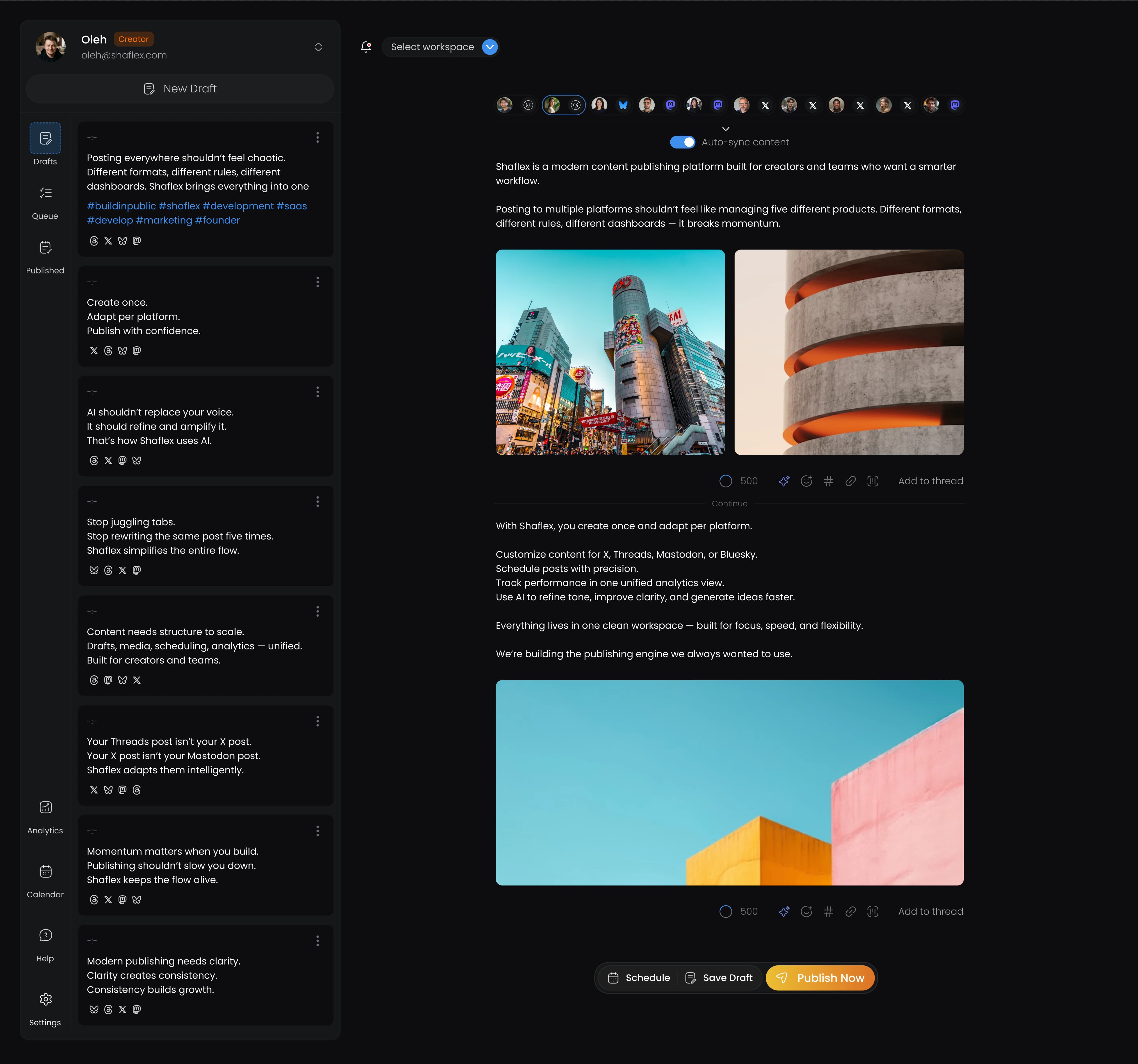
Shaflex lets you write once and publish to X, Threads, Bluesky, Mastodon, and LinkedIn in one click. Character limits adjust automatically. Scheduling handles the timing. You focus on the ideas.
Start free with 3 channels and 30 posts per month. Scale your posting volume strategy without scaling your hours.

 Apr 22, 2026