You know you should be posting. You open your phone, stare at the screen, and close it again because you have no idea what format to use. Should you write a thread? Record a talking-head video? Go live? Post a carousel? The answer depends on what you are trying to build. If your goal is a personal brand that attracts clients, collaborators, or job offers, not all content types are equal. The best content format for personal brand growth is the one that builds the most trust per minute of attention. And trust, as it turns out, follows a clear hierarchy.
This guide breaks down every major content format, ranks them by how much trust they generate, and gives you a concrete plan for choosing where to start. If you have been wondering what to post for personal brand growth, this is the framework.
The Trust Hierarchy: Why Some Content Formats Build Brands Faster
Not every piece of content builds the same amount of trust. A repost builds almost none. A live stream can build more trust in one session than a month of short clips. Here is the trust hierarchy, ranked from highest to lowest:
- Live video and live audio
- Long-form video (10+ minutes)
- Long-form text (1,000+ words)
- Short-form video (under 60 seconds)
- Short-form text (single posts, quick takes)
- Reposts and shares
The pattern is straightforward. The more unfiltered time someone spends with you, the faster they feel like they know you. Live content is at the top because it cannot be edited. Long-form is next because it gives your audience enough depth to evaluate your thinking. Short content is useful for discovery, but it rarely converts a stranger into someone who trusts your judgment.
This is not theory. There is a specific story that illustrates it better than any data set.
The Live Streaming Story: Trust Is Measured in Hours
A high-volume content creator shared a story about a UK vs US soccer event that made the trust hierarchy impossible to ignore. Influencers and creators walked onto the field in front of a packed stadium. The audience reaction told the whole story.
A-list celebrities walked out first. These were people with millions of followers, magazine covers, and household name recognition. The crowd gave them almost nothing. Polite acknowledgment at best.
Short-form creators came next. People with tens of millions of followers on TikTok and Instagram Reels. The crowd gave them a slight reaction. Some scattered cheers, nothing that would shake the rafters.
Then came the long-form creators. YouTubers and podcasters who made content that ran 10, 20, sometimes 60 minutes per episode. The crowd gave them real cheers. Genuine excitement. You could hear the difference.
But the live streamers got the stadium eruption. The building shook. Fans were screaming, standing, losing their composure. These were creators whose audiences had spent hundreds, sometimes thousands, of cumulative hours watching them in real time.
The lesson: trust scales with unedited time spent together. A 15-second clip tells people what you do. An hour-long live stream tells people who you are. The crowd did not cheer loudest for the most famous faces. They cheered loudest for the people they felt they actually knew.
This has direct implications for your content types for personal branding. If you only post short clips, you are introducing yourself to new people over and over again without ever deepening the relationship. If you add long-form and live content, you give your existing audience a reason to invest real attention, and that investment compounds into trust.
Why Video Is the Highest-Trust Format
Video carries more information per second than any other format. Your audience can see your face, hear your tone, read your body language, and judge whether you are being genuine. Text can be carefully crafted. Video is harder to fake.
A social media strategist has spoken extensively about how video continues to dominate personal branding, especially as platforms prioritize video in their algorithms. Every major platform in 2026 gives preferential reach to video content. Threads, LinkedIn, Bluesky, and X all surface video posts more aggressively than text-only posts.
But reach is only half the story. Video also builds familiarity faster. When someone watches you explain a concept on camera, they start to feel like they are in a conversation with you. That parasocial connection is what turns a follower into a fan, and eventually into a customer or collaborator.
You do not need expensive equipment. A phone camera, decent lighting, and a clear point are enough. The bar for production quality in personal branding is lower than most people think. What matters is whether you have something worth saying and whether you say it like yourself.
If you have been treating social media as a broadcast channel, you are missing the bigger picture. Platforms are functioning more like search engines now, and video content is what people search for when they want to evaluate a person, not just a topic.
When to use video
Use video when you are explaining a process, sharing a reaction, teaching a skill, or telling a story that benefits from facial expression and tone. Do not use video for content that works better as a quick text update. Not everything needs to be filmed.
The Best Content Format for Personal Brand Growth Through Text
Video gets the most attention from algorithms, but text is still where many of the strongest personal brands are built. Text posts are faster to create, easier to iterate on, and better suited for certain types of ideas.
The formula that works consistently is: specific insight + personal story + actionable takeaway.
Here is what that looks like in practice.
Specific insight: "Most founders undercharge because they anchor to competitor pricing instead of the value they deliver."
Personal story: "I charged $500 for my first consulting engagement. The client made $40,000 from the advice I gave them in one session. I realized my pricing was based on my comfort level, not the outcome."
Actionable takeaway: "Before your next pricing conversation, write down three specific results your past clients have gotten. Price based on those outcomes, not on what feels safe."
Each piece of that formula does a different job. The insight earns the click. The story builds trust because it is vulnerable and specific. The takeaway gives the reader something to do, which makes them more likely to follow you for the next post.
If you are not sure what to post, start with this formula. Write one post per day using it. After two weeks, you will have a library of content that positions you as someone who has real experience and shares it openly.
For more on why frequency matters, read our breakdown of why posting once a day is not enough. The short version: consistency compounds. Buffer's research on social media consistency shows that accounts posting daily grow followers 2-3x faster than those posting a few times per week. But consistency only works if the content is worth reading. The formula above makes sure it is.
Thread Format: Multi-Part Posts That Build Authority
Threads work on X, Threads (Meta), and Bluesky. They let you break a longer idea into digestible pieces, and they perform well because each post in the thread can surface independently in feeds.
A thread is not just a long post broken into chunks. A good thread has a structure:
Hook post: State the problem or the surprising claim. This is the only post most people will see, so it needs to stand on its own. "I spent $50,000 on ads before I realized organic content converts 3x better. Here is what I learned."
Body posts (3-7 posts): Each one makes a single point with a specific example. Do not repeat yourself across posts. Every post should add something new.
Closing post: Summarize the key points and include a clear next step. Ask a question, link to a resource, or invite people to share their own experience.
Threads work because they reward curiosity. If the hook is strong enough, people will click through the entire sequence. And the threading format signals effort, which signals expertise.
The cross-platform angle matters here. A thread you write on X can be adapted for Threads and Bluesky with minimal changes. The structure translates. This is one of the strongest personal brand content strategy moves because you produce once and distribute three times.
If you are building in public, threads are particularly effective for sharing progress updates, lessons learned, and decision breakdowns. The format gives you room to go deep without asking your audience to commit to a full article.
Series Content: Recurring Formats Build Recognition
One-off posts are forgettable. Series are not. When you commit to a recurring format, your audience starts to expect it, look forward to it, and associate it with you.
Examples of series that work:
- "What I learned this week" every Friday. Share one business lesson, one personal observation, and one resource you found useful.
- "Build log" every Monday. Show what you shipped, what broke, and what is next.
- "Tool of the week" on Wednesdays. Review one tool you actually use and explain why it is in your stack.
- "Ask me anything" once a month. Go live or post a thread answering questions from your audience.
The power of a series is pattern recognition. When someone sees your name in their feed, they immediately know what kind of value to expect. That predictability builds trust faster than a random collection of unrelated posts.
Series also solve the "what should I post today" problem permanently. You do not need to generate a new idea from scratch every day. You need to fill in a template that your audience already cares about.
Buffer's research supports this directly. Their data shows that consistent, predictable posting schedules outperform sporadic bursts of content, even when the sporadic bursts include higher-quality individual posts. Regularity beats brilliance when it comes to audience growth.
Carousel and Document Posts on LinkedIn: 6.6% Engagement
LinkedIn carousels (uploaded as PDF documents) consistently outperform every other format on the platform. Data shows that carousel posts achieve an average engagement rate of 6.6%, which is the highest of any content format on LinkedIn. For context, standard text posts average around 2-3%, and video posts sit between 3-4%.
Why do carousels work so well? Three reasons.
First, they stop the scroll. A multi-slide visual format is inherently more attention-grabbing than a wall of text in a feed full of text.
Second, they reward swiping. Each swipe is a micro-commitment. By the time someone has swiped through 8 slides, they have invested real attention in your content, and that investment makes them more likely to like, comment, or share.
Third, carousels let you combine visual design with structured thinking. A well-made carousel distills a complex idea into a clear, step-by-step visual sequence. That combination of clarity and design signals expertise more effectively than a long text post.
Here is a practical example. Say you are a product designer. You could write a text post about your design process. It would get some engagement. Or you could create a 10-slide carousel titled "My 5-Step Process for Designing Features That Ship" with one slide per step, each including a screenshot from a real project. The carousel version will outperform the text version by 2-3x in most cases.
If you are building a personal brand on LinkedIn specifically, carousels should be part of your regular rotation. Aim for one per week. Use a simple design tool, keep each slide to one idea, and end with a slide that asks a question or invites a response.
Matching Format to Platform
Every platform has a native format that performs best. Fighting the native format is a losing strategy. Here is the breakdown for 2026:
X (Twitter): Short text posts and threads. Video is gaining ground, but the culture still rewards sharp writing. Threads are the power format for building authority.
Threads (Meta): Text-first, but longer posts perform well. The algorithm rewards conversation, so posts that ask questions or invite responses outperform broadcasts. Threads does not support threaded multi-post sequences the same way X does, so adapt accordingly.
Bluesky: Similar to early Twitter. Short, opinionated text posts do well. The community values authenticity over polish. Threads work here too, and the audience tends to reward specificity over vague motivational content.
LinkedIn: Carousels for engagement, long text posts for reach, video for authority. LinkedIn rewards content that generates comments, so structure your posts to invite discussion. The professional context means your personal brand content strategy should lean toward industry insights and career lessons.
Telegram: Long-form text with links. Telegram channels function more like newsletters than social feeds. If you have a Telegram presence, use it for your deepest, most detailed content.
The mistake most people make is trying to be everywhere with the same content. A carousel that works on LinkedIn will not work on X. A punchy one-liner that works on X will get buried on LinkedIn. Match the format to the platform, and you will get better results with less effort.
For a deeper look at how to adapt content across platforms, check out our guide on using AI to streamline content creation without losing your voice.
Master One Format Before Adding Another
This is where most personal branding advice falls apart. People read a guide like this one and try to do everything at once. They start a weekly carousel series, launch a YouTube channel, go live on Threads, and write daily tweets. Two weeks later, they are burned out and posting nothing.
The better approach: pick one format and one platform. Get good at it. Build a rhythm. Then add the next one.
Here is a suggested progression:
Month 1-2: Daily short text posts on one platform. Learn to write clearly and concisely. Develop your voice. Find out which topics your audience responds to.
Month 3-4: Add a weekly long-form piece. This could be a thread, a LinkedIn carousel, or a blog post. Use your daily posts as a testing ground for ideas, then expand the ones that resonate.
Month 5-6: Add video. Start with short clips if the camera makes you uncomfortable. Graduate to longer formats as you build confidence.
Month 7+: Experiment with live content. Go live once a week for 15-30 minutes. Answer questions, share updates, or work through a problem in real time.
This progression works because each stage builds on the last. Your daily text posts teach you what ideas resonate. Your weekly long-form content deepens those ideas. Your video content adds a face and voice to the thinking. And your live content creates the highest-trust connection with the people who have been following along since month one.
The compounding effect is significant. By month seven, you have a library of content across multiple formats, a clear voice, a tested set of topics, and an audience that trusts you because they have spent hours with your ideas.
Consistency Beats Virality Every Time
One viral post will spike your follower count for a day. Consistent posting at a decent quality level will build a personal brand that generates opportunities for years.
This is not a feel-good platitude. Buffer's data shows that accounts maintaining a daily posting schedule for 90+ days see compounding returns in reach and engagement, even if no single post goes viral. The algorithm rewards reliability because reliable creators keep users on the platform.
Your personal brand content strategy should optimize for consistency first and virality never. You cannot engineer a viral moment, but you can engineer a schedule. Post daily. Use the formula. Pick formats that match your strengths and your platform. Show up even when the engagement is low.
The accounts that break through are rarely the ones with the single best post. They are the ones that posted good content 300 days in a row.
Putting It Together: Your Content Format Strategy
Here is the decision framework:
- What platform is your audience on? Start there. Do not spread yourself thin.
- What format is native to that platform? Use it. Do not fight the algorithm.
- What format matches your strengths? If you write well, start with text. If you are comfortable on camera, start with video. If you are a natural teacher, try carousels.
- What can you do consistently? The best format is the one you will actually produce every day. A daily text post beats a weekly video you skip half the time.
Build the habit first. Optimize the format second. Add new formats only when the current one feels automatic.
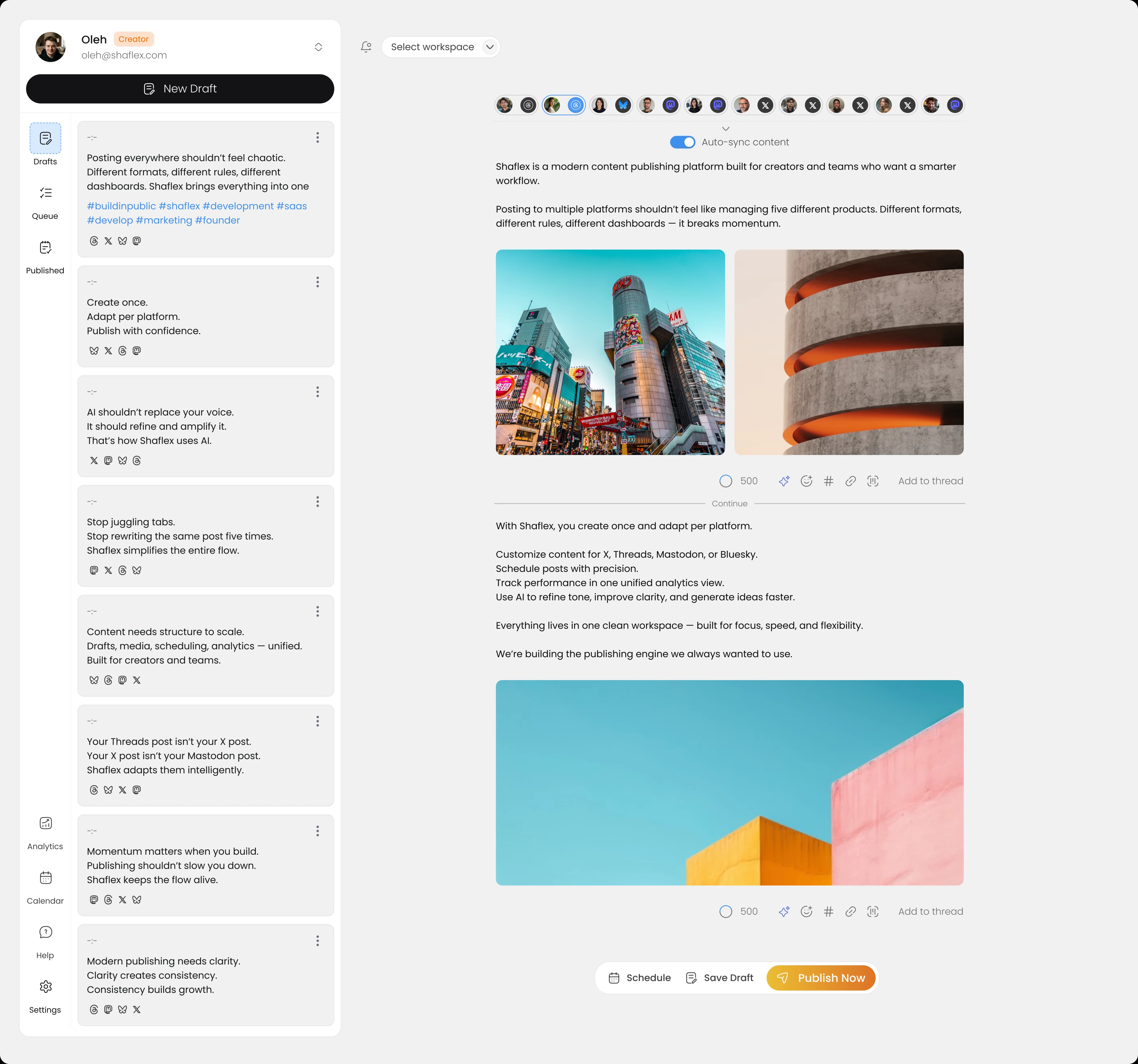
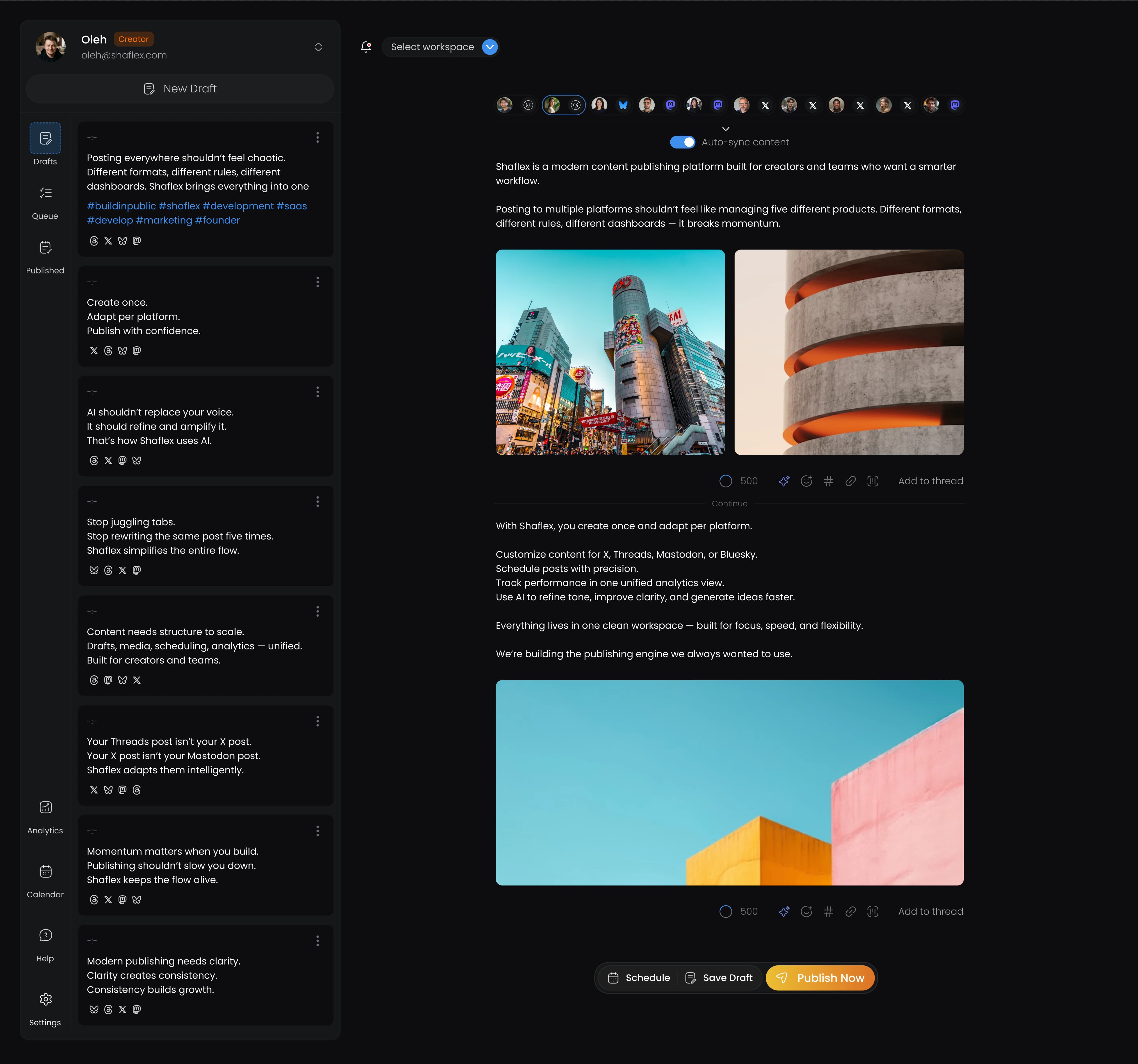
If you are looking for a tool that lets you draft, schedule, and publish across X, Threads, Bluesky, LinkedIn, and Telegram from a single dashboard, Shaflex was built for exactly this. Write once, adapt per platform, and maintain the consistency that makes content formats actually work. Create your free account and start building the posting habit that compounds into a real personal brand.

 Apr 22, 2026