Most founders know they should share their journey online. Few know how to do it without spending two hours a day on content. Building in public still works in 2026, but the playbook has changed. Short clips and daily screenshots are not enough. The founders gaining real traction are the ones sharing longer, deeper content across multiple platforms, adapting their message to each audience, and showing up consistently without burning out.
This is not a motivational post about "being transparent." This is a founder content strategy you can execute in under 30 minutes a day. It covers what to post, where to post it, how to adapt your message per platform, and how to measure whether any of it is working.
If you have read our introductory guide to building in public on social media, consider this the advanced version. Same philosophy, more depth, more structure.
Why Building in Public Rewards Long-Form Content
A high-volume content creator shared a story about a UK vs US soccer event where influencers walked onto the field in front of a live crowd. A-list celebrities got almost no applause. Short-form creators got polite claps. Long-form creators got real cheers. But live streamers got the stadium eruption. The crowd went loud for the people they had spent the most hours watching.
The takeaway is simple: trust scales with time spent, not impressions counted.
A 15-second clip tells people what you do. A 10-minute video or a 1,500-word post tells people who you are. It gives your audience enough context to test your thinking against their own experience and decide whether to follow you for the long haul.
This does not mean you should stop making short content. Short content introduces you to new people. Long content converts those people into followers who pay attention, share your posts, and eventually buy what you sell.
The compounding effect is real. Someone reads your detailed breakdown, tries your advice, gets a result, and comes back for more. You cannot fit that reinforcement loop into a 30-second reel. You need enough depth for your audience to run a small experiment based on your thinking and see that it works.
For founders, this is especially powerful. Your product updates, growth lessons, and technical decisions are all content that naturally runs long. Lean into that.
The Founder Content Strategy: Five Pillars
Before picking platforms, you need a framework for what to actually say. Every building in public social media post you write should fit into one of five categories.
1. Progress Updates
What you shipped this week. What broke. What the numbers look like. These are the bread and butter of building in public. Keep them specific. "We added a scheduling feature" is forgettable. "We shipped timezone-aware scheduling after 3 users in Tokyo reported posts going out at 4 AM" tells a story.
2. Lessons and Mistakes
The posts that get the most engagement are the ones where you admit something went wrong and explain what you learned. People remember vulnerability more than victory laps. Share the debugging session that ate your Wednesday. Share the pricing change that backfired.
3. Decisions and Reasoning
Why you chose GraphQL over REST. Why you picked Bluesky over Mastodon as your first integration. Why you charge monthly instead of annually. Decision posts position you as thoughtful, and they start conversations because readers have their own opinions.
4. Numbers and Metrics
Revenue, traffic, conversion rates, churn. Share them in context. "$5K MRR" means nothing alone. "$5K MRR, up from $2.8K after we added a free trial" tells a story your audience can learn from. For more on which numbers actually matter, see our guide on analytics metrics that actually matter.
5. Behind the Scenes
Screenshots of your workspace. A pull request review. A design iteration showing before and after. A photo of the whiteboard where you mapped out your roadmap. These posts humanize you and make your audience feel like insiders.
Every week, aim to hit at least three of these five categories. That gives you variety without requiring you to invent something new every day.
Platform-by-Platform Breakdown: Where to Post and How
Each platform has a different audience, different formatting constraints, and different expectations. Posting the same text everywhere is copy-pasting, not cross-platform posting. Here is what works where.
X (formerly Twitter)
X remains the default platform for building in public. The culture rewards fast opinions, real-time reactions, and specific numbers.
Character limit: 280 for free accounts, 25,000 for Premium subscribers. But long posts get buried. Stay under 280 for single posts. Use threads for anything longer.
What works: "We hit $5K MRR today. Here's the one change that got us there." Short, specific, anchored by a number or a result. Threads work well for step-by-step breakdowns, but front-load the hook in the first tweet.
What to avoid: Long essays in a single post. Promotional language. X audiences are allergic to anything that reads like a press release.
Posting cadence: 1-2 times per day. X rewards frequency, but only if each post carries a specific insight or update.
LinkedIn
LinkedIn audiences want to know what your experience means for their business. The tone is professional but increasingly personal. Story-driven posts outperform listicles.
Character limit: 3,000 for regular posts. Articles allow much more, but posts get 5-10x the reach of articles.
What works: "I fired our best salesperson. Revenue went up. Here's why." Personal story with a business lesson. 500-1,000 words. Open with a hook that creates tension. Use line breaks aggressively. LinkedIn's algorithm rewards dwell time, so longer posts that keep people scrolling perform well.
What to avoid: Technical details without business context. Code snippets. Jargon that only developers understand. Save the technical content for Bluesky.
Posting cadence: 3-5 times per week. LinkedIn penalizes posting more than once per day, so space your content out.
Bluesky
Bluesky has become the home of developers, early adopters, and open-source enthusiasts. The audience skews technical and values substance over polish.
Character limit: 300 characters per post. This is tight. You need to be precise.
What works: Technical decisions, open-source contributions, API choices, infrastructure updates. "We switched from REST to GraphQL. Here's what broke." Link to a blog post or thread for the full story. Bluesky's community rewards genuine sharing and penalizes self-promotion.
What to avoid: Marketing language. CTAs. Anything that reads like an ad. This audience can spot a pitch instantly and will unfollow.
Posting cadence: Once daily or every other day. Quality over quantity. If you are new to Bluesky, our guide on how to schedule Bluesky posts covers the mechanics.
Mastodon
Mastodon is a text-first, community-driven network that values accessibility and genuine sharing. Self-promotion gets unfollowed fast.
Character limit: 500 characters on most instances, though some allow more.
What works: Honest updates about your project without a sales angle. Alt text on every image (this is a strong cultural norm, not optional). Contributing to conversations, boosting others, and being a community member first. "Been working on timezone support for our scheduler. Turns out IANA timezone data has some fascinating edge cases" reads like a person talking, not a brand broadcasting.
What to avoid: Cross-posted marketing content. Automated reposts that include hashtag spam. Anything with a hard CTA. On Mastodon, you earn trust by being a person first and a founder second.
Posting cadence: 3-4 times per week. See our walkthrough on how to schedule Mastodon posts for tips on maintaining consistency without flooding timelines.
Threads
Threads has a broader, more casual audience than X or Bluesky. Image posts outperform text by 2-3x. The tone is conversational.
Character limit: 500 characters per post.
What works: Screenshots of your product, before-and-after visuals, casual "here's what I'm working on" posts with images attached. Threads rewards visual content and personal voice. A photo of your desk with a caption about what you are building today will outperform a text-only metric update.
What to avoid: Pure text walls. Dense business lessons without visual elements. Content that feels like it belongs on LinkedIn. For a deeper comparison of how Threads and Bluesky differ for creators, read our Bluesky vs Threads breakdown.
Posting cadence: Daily if possible. Threads favors consistent daily posting and the algorithm surfaces frequent posters.
The Weekly Content Rotation
Consistency matters more than volume. Here is a simple rotation that covers all five content pillars and takes less than 30 minutes per day to execute.
| Day | Content Pillar | Example Post |
|---|
| Monday | Progress Update | "This week: shipping the new analytics dashboard. Here's the mockup." + screenshot |
| Tuesday | Lesson or Mistake | "We lost 3 hours debugging a timezone bug. The root cause was daylight saving time transitions in Brazil." |
| Wednesday | Numbers and Metrics | "Blog traffic up 40% since we started adding internal links to every post. Here's the before/after." |
| Thursday | Behind the Scenes | Screenshot of your workspace, a Figma file, or a code review thread |
| Friday | Decision or Reflection | "Biggest win: first paying customer from LinkedIn. Biggest miss: still no Mastodon traction. Here's what we're changing." |
You do not need to post on every platform every day. Pick two or three platforms per post and adapt the format. Monday's progress update might go on X (short version with the key number) and LinkedIn (longer version with the backstory). Thursday's behind-the-scenes screenshot fits Threads and Bluesky.
Cross-Platform Posting Without Sounding Robotic
The core idea can stay the same across platforms. The framing needs to change. This is the difference between cross-platform posting and lazy copy-pasting.
Start by writing the LinkedIn version first. It is the longest and most detailed. Then adapt.
For X: Pull out the hook and the key number. Cut to under 280 characters. If the story needs more room, make it a thread with 3-5 tweets.
For Bluesky: Condense to 300 characters. Lead with the technical angle. Drop the business framing and add specifics about your stack or approach.
For Threads: Add an image. Rewrite the first line to be casual and visual. "Look at this" beats "I'm pleased to announce."
For Mastodon: Rewrite in a personal, community-friendly tone. Drop any CTA. Add alt text to images. Frame it as sharing, not promoting.
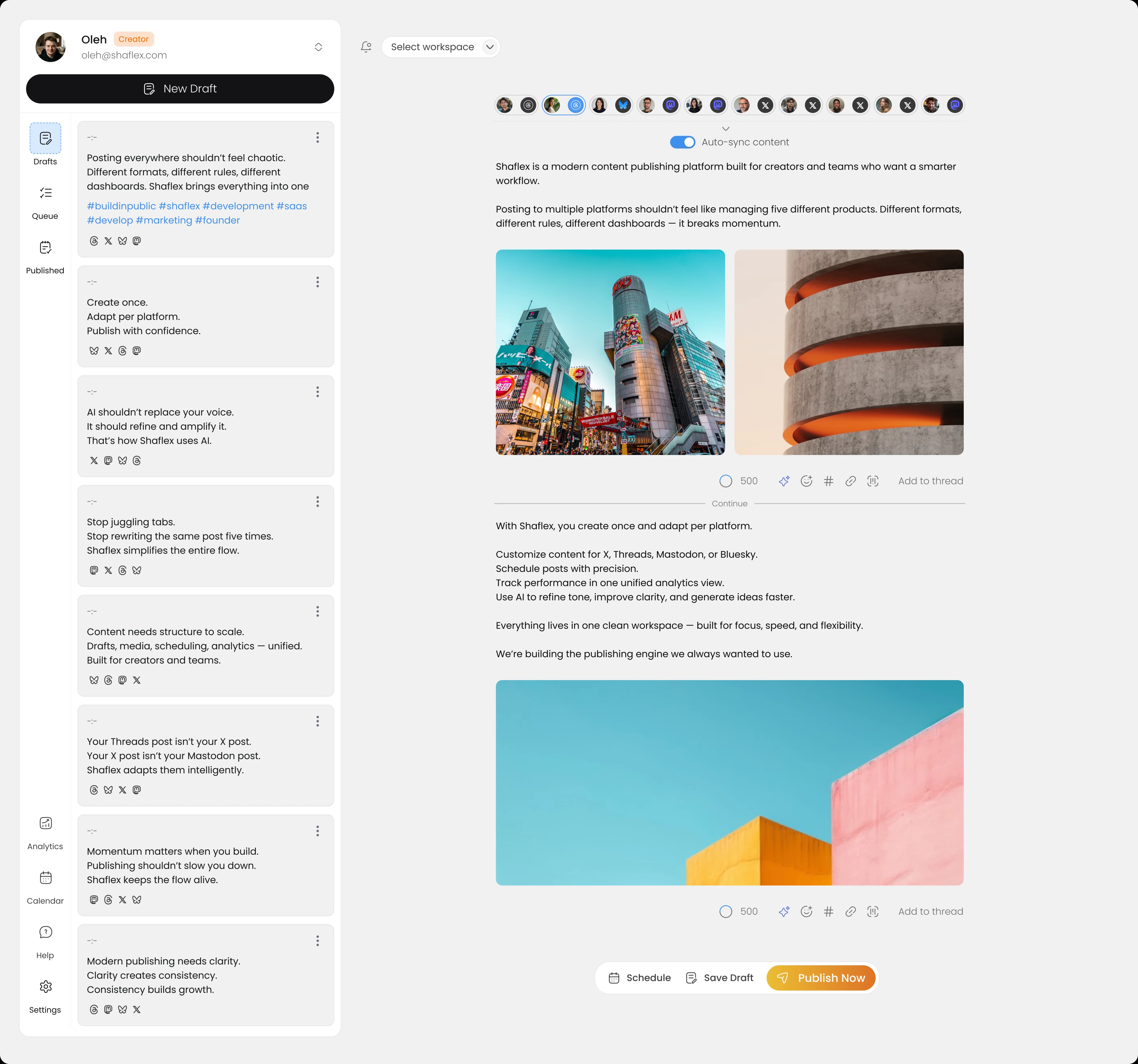
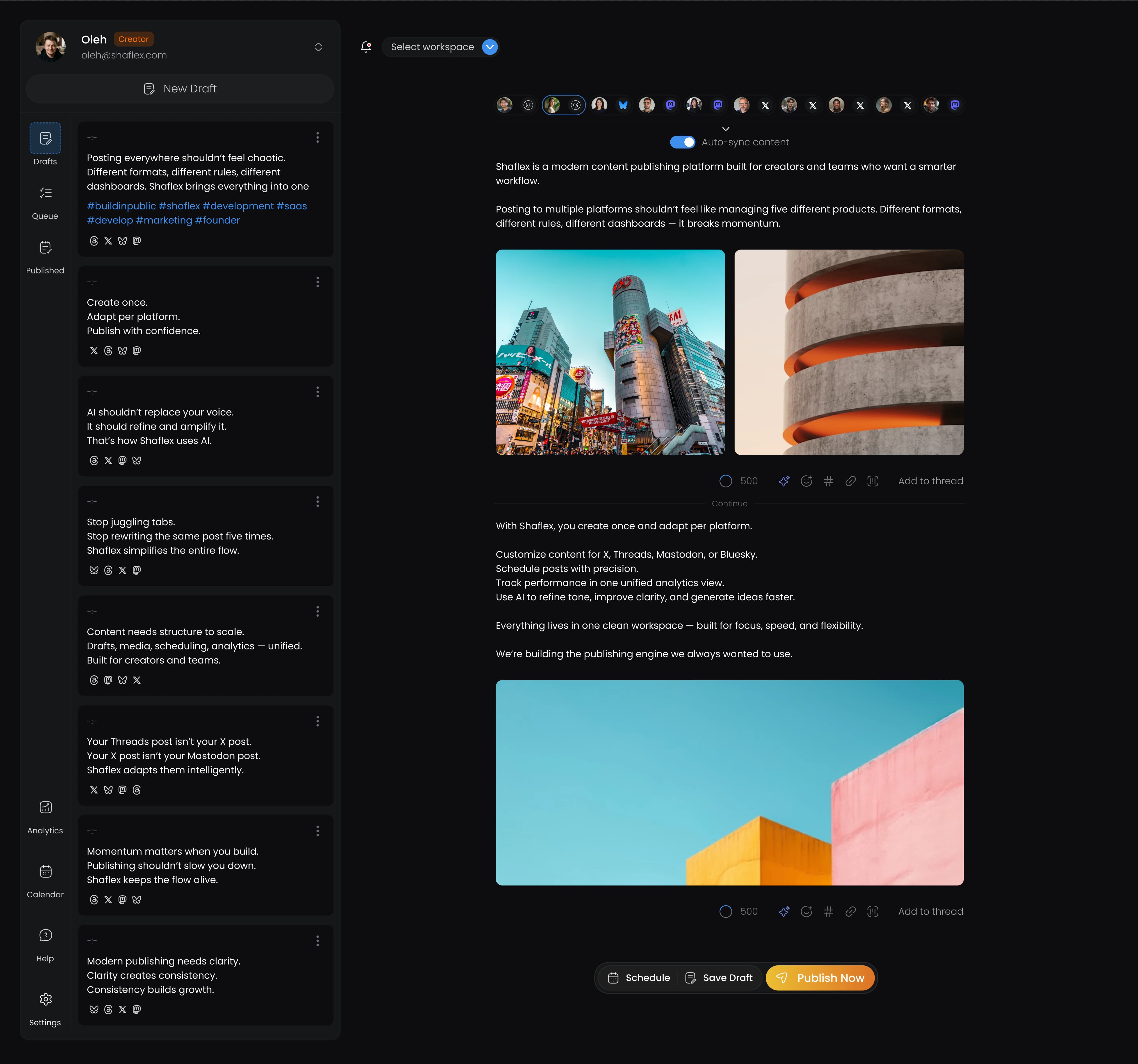
This process takes about 10 minutes once you have the LinkedIn draft. A scheduling tool can handle the timing and character validation so you are not switching between five tabs and checking limits manually.
Measuring What Actually Works
Forget follower count. Followers are a vanity metric for building in public. The numbers that tell you whether your content is working are more specific.
Engagement Velocity
How fast do people react in the first 60 minutes? This is the signal that determines your reach on LinkedIn and X. Both platforms use early engagement to decide whether to push your post to a wider audience. If your first hour is dead, the post is dead.
To improve this, post when your audience is online (not when it is convenient for you) and open with a line that stops the scroll. Questions, surprising numbers, and counterintuitive claims all work.
Saves and Shares
Someone saving your post means it was useful enough to come back to. That is the strongest signal of content quality. On X, bookmarks serve this function. On LinkedIn, saves and shares both count. Track these weekly, not daily.
Inbound Messages
If strangers DM you after a post saying "I have the same problem" or "can I pick your brain about this," your content is working. Inbound messages are the leading indicator of future customers, collaborators, and advocates.
Reply Quality
Five thoughtful comments beat fifty "great post" replies. Look at what people say, not how many people react. If your posts generate substantive replies where people share their own experiences or challenge your thinking, you are building a real audience.
Track these four metrics weekly in a simple spreadsheet. Building in public is a long game. The compounding takes 3-6 months to feel real, but when it kicks in, your audience becomes a growth engine that no ad budget can replicate.
Common Mistakes That Kill Momentum
Posting the Same Thing Everywhere
We covered this above, but it is worth repeating. When you paste identical text across five platforms, people who follow you on multiple networks see it and lose trust. Each platform has a culture. Respect it.
Only Sharing Wins
An endless stream of "we hit X milestone" posts reads as performance, not transparency. The posts that build the deepest trust are the ones where you share what went wrong, what you do not know yet, and what you are still figuring out.
Disappearing for Two Weeks
Consistency beats intensity. Posting five times in one day and then going silent for 10 days is worse than posting three times a week every week for a year. The weekly rotation above is designed to be sustainable. If you cannot do five posts a week, do three. Just do not stop.
Ignoring Replies
Building in public is a two-way conversation. If someone takes the time to reply to your post with a question or their own experience, respond. Every reply you write is content that other people see. It signals that you are present, engaged, and worth following.
Treating It Like Marketing
The moment your building-in-public content starts reading like a brand account, you lose the thing that makes it work: the feeling that a real person is sharing a real journey. Write like yourself. Use your own voice. Skip the corporate tone.
How to Start This Week
If you have never built in public before, here is your first week.
Day 1: Write a post on X or LinkedIn introducing what you are building and why. Keep it under 500 words. Include one specific number (users, revenue, weeks since launch, anything concrete).
Day 2: Share a screenshot on Threads showing your product, your workspace, or your roadmap. Add a one-sentence caption.
Day 3: Post a technical decision on Bluesky. "We chose X over Y because Z." Keep it under 300 characters.
Day 4: Write about a mistake or something that surprised you. Post on LinkedIn (long version) and X (short version).
Day 5: Share a number. Revenue, traffic, signups, retention. Put it in context. Post on X and LinkedIn.
That is five posts across four platforms. Each one takes 5-10 minutes. By the end of the week, you have a rhythm. By the end of the month, you have an audience that knows your name, your product, and your story.
The Long Game
Building in public is not a growth hack. It is a compounding investment in trust. The founders who win with this strategy are the ones who show up consistently for months, not the ones who go viral once and disappear.
Every post you write is a data point that tells your audience who you are. Over time, those data points stack into something that no landing page or ad campaign can create: a relationship with people who genuinely care about what you are building.
The tools exist to make this sustainable. You do not need to log into five platforms every morning. You need one place to write, adapt, schedule, and track your content across all of them.
Share your building-in-public journey across X, Threads, Bluesky, Mastodon, and LinkedIn from one editor. Try Shaflex free.


 Apr 22, 2026