Most founders treat LinkedIn like a digital resume. They update it when they raise a round, post the occasional company milestone, and wonder why nobody engages. Meanwhile, other founders in their space are pulling in warm leads every week without running a single ad.
The difference is LinkedIn personal branding. Not the fluffy "build your brand" advice that's been recycled since 2018. The specific, measurable approach that works with the LinkedIn algorithm 2026 actually uses to rank and distribute content. Personal profiles now generate 8x more engagement than company pages, and that gap has only widened over the past 12 months.
If you are a founder posting on LinkedIn and getting crickets, this guide breaks down exactly what changed, what the algorithm rewards, and how to turn your profile into a lead generation channel.
Why does LinkedIn personal branding matter more in 2026?
LinkedIn crossed 1.2 billion members in early 2026. But the number that matters is not total users. It is the percentage of those users who actually post. Less than 2% of LinkedIn users create content regularly. That means the bar for standing out is remarkably low compared to platforms like Threads or X.
For founders, the math is even more compelling. Inbound outreach from personal content converts at 14.6%, according to data from LinkedIn's own B2B marketing reports. Traditional outbound, cold emails and InMails, converts at 1.7%. That is not a marginal improvement. That is a fundamentally different approach to generating pipeline.
Company pages still have their place for employer branding and product announcements. But when it comes to trust, reach, and conversion, people follow people. Your personal profile is where deals start.
This is why a clear LinkedIn growth strategy matters more now than at any point in the platform's history.
How does the LinkedIn algorithm work in 2026?
The algorithm is not a mystery. LinkedIn has been increasingly transparent about what drives distribution, and third-party studies have confirmed the patterns. Three factors determine whether your post reaches 500 people or 50,000.
Connection Strength
LinkedIn tracks every interaction: profile views, message exchanges, comment replies, post reactions. When you publish, the algorithm first shows your post to people you have interacted with recently. If those people engage, it expands to their networks.
This means your reach depends on the relationships you have built, not just your follower count. A founder with 3,000 connections who comments actively will outperform one with 30,000 connections who never engages.
Engagement Velocity
The first 60 minutes after you publish are the most critical window. LinkedIn calls this the "golden hour." If your post receives comments, reactions, and shares during this period, the algorithm classifies it as high-quality content and pushes it further into the feed.
Posts that get no engagement in the first hour get buried. It does not matter how good the content is. Timing and initial traction determine everything.
Content Authenticity
LinkedIn's 2026 updates included stronger signals for detecting formulaic, templated content. Posts that read like press releases or recycled platitudes get penalized in distribution. Posts that sound like a real person sharing a real experience get rewarded.
The algorithm now analyzes sentence structure, vocabulary diversity, and engagement patterns to assess whether content is authentic. This is not about being casual or unprofessional. It is about being specific and genuine.
When should you post on LinkedIn for maximum reach?
Since engagement velocity in the first 60 minutes drives everything, your posting schedule becomes a strategic decision, not an afterthought.
The 2026 data points to Tuesday through Thursday, between 15:00 and 16:00 UTC, as the highest-engagement windows for B2B content. Monday mornings are cluttered with weekend recaps. Fridays drop off as people shift into weekend mode.
But the global window only matters as a starting point. Your actual best time depends on where your audience is. If you sell to European SaaS companies, posting at 09:00 CET will outperform a late-afternoon slot. If your buyers are US-based VPs of Marketing, 08:00 EST catches them during their morning scroll.
For a deeper look at how timing varies across platforms, the research in our best times to post on Threads guide covers overlapping patterns that apply to LinkedIn scheduling as well.
Here is what the first-hour rule means in practice:
- Post when your audience is online. Check your LinkedIn analytics to see when your followers are active. Adjust weekly.
- Stay present for 30 to 60 minutes after publishing. Reply to every comment. Ask follow-up questions. Keep the conversation alive.
- Seed engagement before you post. Spend 15 minutes commenting on other people's posts in your niche right before you publish. This puts you in front of your network and primes reciprocity.
- Never post and disappear. The algorithm watches whether you participate in the conversation you started. Posting at 7 AM and checking back at noon means you have already lost the window.
What content formula actually builds founder brands on LinkedIn?
The posts that consistently drive engagement and inbound leads follow a repeatable structure. This is not a hack. It is a communication pattern that works because it respects how people process information on a feed.
Specific insight + personal story + actionable takeaway.
Here is what each element does.
Specific Insight
Generic statements get scrolled past. "Leadership matters" teaches nothing. "I tracked our team's output for 90 days after switching to async standups, and shipping velocity went up 34%" gives the reader a concrete data point they can evaluate.
Specificity is what makes content believable. Numbers, dates, percentages, and named tools create credibility. You do not need a PhD or a massive dataset. Even a single observation from running your business counts, as long as it is precise.
Personal Story
The story is what makes the insight memorable. It answers the question: "Why should I care about this person's perspective?"
For founders, the best stories come from building their companies. Hiring mistakes. Product pivots. Customer conversations that changed your roadmap. The vulnerability of sharing what went wrong is what separates content that spreads from content that sits.
Example: "I fired our highest-performing salesperson last month. Revenue went up 15%. Here is what I learned about toxic top performers and the metrics that hide the damage."
That post works because it is counterintuitive, specific, and rooted in a real decision.
Actionable Takeaway
Every post should leave the reader with something they can apply. A framework. A checklist. A question to ask themselves. If someone reads your post and thinks "interesting" but has no next step, you have entertained but not converted.
The takeaway is also what drives saves and shares, two engagement signals the algorithm weights heavily.
What types of LinkedIn posts drive the most engagement for founders?
Not every post needs to be a 1,500-word essay. Variety keeps your audience engaged and tests what resonates. Here are the five formats that consistently perform for founder accounts in 2026.
1. The Contrarian Take
Challenge a commonly held belief in your industry with evidence from your own experience. "Everyone says you need a content calendar. We stopped using one six months ago and our engagement tripled. Here is why rigidity kills creativity."
This format works because it creates tension. People click to see if you can back up the claim.
2. The Behind-the-Scenes Build
Share what you are actually working on. Screenshots of your dashboard, a Loom walkthrough of a new feature, the whiteboard from your last strategy session. Founders who build in public create a narrative people want to follow.
This approach overlaps with the broader building in public playbook that many successful founders use across multiple channels.
3. The Lesson From Failure
Posts about what went wrong outperform posts about what went right by a wide margin. The reason is simple: failure stories feel honest, and they provide lessons the reader can avoid.
"We spent $40K on a rebrand that tanked our conversion rate. Here are the three assumptions we got wrong and how we fixed it in two weeks."
4. The Framework Post
Take something complex and break it into a step-by-step process. Founders who can simplify hard problems position themselves as experts. Use numbered lists, short sentences, and one clear outcome.
"My 3-step process for qualifying enterprise leads in the first call: (1) Ask about their current stack. (2) Identify the manual workaround. (3) Quantify the cost of doing nothing."
5. The Data Post
Share original data, even from small samples. "I analyzed 200 cold emails I received last quarter. 94% opened with the same three templates. Here is what the 6% who got replies did differently."
Original data is rare on LinkedIn. That scarcity makes it valuable and shareable.
How do LinkedIn comments drive distribution for your own posts?
Most LinkedIn strategy founders hear focuses on publishing. But the founders building the fastest-growing brands spend as much time in comments as they do writing posts.
A single thoughtful comment on a popular post in your niche can drive more profile views than your own post. Comments show up in your network's feed. They position you in conversations that already have attention. And they build the connection-strength signals that make the algorithm show your next post to more people.
Here is how to treat commenting as a growth strategy:
- Comment on 5 to 10 posts in your niche before publishing your own. This warms up the algorithm and puts your name in front of the people you want reading your content.
- Write substantive comments, three or more sentences. "Great post!" does nothing. Add a perspective, share a related experience, or respectfully disagree with a specific point.
- Reply to every comment on your own posts within the first hour. This is non-negotiable. Each reply creates a new notification that pulls commenters back into the thread, generating additional engagement signals.
- Tag people only when genuinely relevant. Engagement-bait tagging gets flagged by the algorithm and annoys the people you tag. If you reference someone's work, tag them. Otherwise, do not.
How should you optimize your LinkedIn profile to convert visitors?
Your LinkedIn profile gets viewed every time someone reads your post, sees your comment, or receives your connection request. Most profiles waste this attention by listing job titles and responsibilities. In 2026, your profile is your landing page.
Headline
You get 220 characters. Do not waste them on "CEO at Company Name." Your headline should answer the question: "What do you help people with?"
"Helping B2B SaaS founders grow revenue through organic social" is a headline that attracts the right profile visitors. "CEO | Entrepreneur | Visionary" is a headline that says nothing.
Banner Image
Your banner is the largest visual element on your profile. Use it to communicate your value proposition, feature a key stat, or promote your product. Do not use your company logo alone. Most viewers will not recognize it.
Featured Section
Pin three to four pieces of content: your best-performing post, a link to your product, a lead magnet, or a case study. This is your above-the-fold call to action. Treat it like the hero section of a website.
About Section
Write in first person. Tell your story in three to four short paragraphs: what problem you noticed, what you built to solve it, and what results your customers get. End with a clear next step. "Send me a message if..." or "Check out [product] if you want to..."
Experience Section
For your current role, write about the impact you are creating, not your responsibilities. "Grew organic social reach from 10K to 500K monthly impressions" beats "Responsible for social media strategy."
How often should you post on LinkedIn for compounding growth?
The founders who generate consistent inbound from LinkedIn post three to four times per week. Not once a month when inspiration strikes. Not five times a day in a burst of motivation. Three to four times, every week, for months.
LinkedIn personal branding compounds. Your first 50 posts might average 15 to 20 reactions each. By post 100, you will notice a core group of people engaging consistently. By post 200, you will have a network that expects your content and actively looks for it.
This consistency is easier to maintain when you batch your content creation and schedule posts in advance. Managing a publishing cadence across LinkedIn and other platforms, like Threads, Bluesky, or Mastodon, is exactly the kind of workflow that breaks down without the right tools. Our guide on cross-posting to multiple platforms covers how to maintain a consistent presence without spending your entire day switching between apps.
The key is showing up predictably. Your audience should know roughly when to expect your content. That reliability builds trust, and trust is what converts followers into customers.
Which LinkedIn metrics actually matter for founders?
Vanity metrics will mislead you. Follower count and impression numbers feel good but do not translate directly to business outcomes. Here are the metrics that actually indicate whether your LinkedIn strategy is working.
Profile Views Per Week
This is your top-of-funnel metric. If your profile views are increasing week over week, your content is reaching new people. A steady climb from 100 to 300 to 500 weekly views means your distribution is expanding.
Engagement Rate Per Post
Calculate this as (reactions + comments + shares) divided by impressions. A healthy engagement rate on LinkedIn is 2% to 5%. Below 1% means your content is not resonating. Above 5% means you have found a format or topic that your audience cares about deeply.
Inbound Messages Per Month
The metric that matters most for founders: how many people reach out to you after reading your content. Track this monthly. If you are posting consistently and your inbound messages are flat, your content is entertaining but not converting. Adjust your calls to action.
Connection Request Quality
Are the people requesting to connect relevant to your business? If you are attracting other founders and potential customers, your positioning is working. If you are mostly getting requests from sales reps and recruiters, your profile and content need sharper targeting.
For a broader framework on which social metrics actually drive business results, our analytics metrics that matter guide breaks down the numbers worth tracking across every platform.
What common mistakes kill LinkedIn reach?
Knowing what to do is half the equation. Knowing what to avoid is the other half. These are the patterns that consistently suppress reach and erode trust.
Posting company announcements without a personal angle. "We just raised $5M" gets a fraction of the engagement that "I almost shut down this company twice before we raised $5M. Here is what I would tell other founders in the valley of despair" gets.
Using hashtags as a crutch. LinkedIn reduced the algorithmic weight of hashtags in 2025. Three to five relevant hashtags are fine. Fifteen hashtags stuffed at the bottom of every post signal low-quality content.
Inconsistent posting. Publishing five posts in one week and then going silent for a month confuses the algorithm and trains your audience to forget you exist.
Ignoring comments on your own posts. When someone takes the time to comment and you do not reply, you are telling the algorithm this conversation is not important. You are also telling that person their input does not matter.
Copying templates verbatim. The "I'm thrilled to announce" and "Agree?" formats have been overused to the point of parody. The algorithm now deprioritizes posts that match known engagement-bait templates.
What does a weekly LinkedIn playbook for founders look like?
Here is a practical weekly schedule that applies everything above. Adjust the specifics to your niche and audience, but keep the structure.
Monday: Review last week's analytics. Identify your top-performing post and note why it worked. Spend 20 minutes commenting on posts in your niche.
Tuesday: Publish your first post of the week. Stay active in comments for the first hour. Respond to any inbound messages from the previous week.
Wednesday: Comment-only day. Spend 30 minutes writing substantive comments on 10 posts from people in your target market. No publishing.
Thursday: Publish your second post. Use a different format than Tuesday. If Tuesday was a story, Thursday could be a framework or data post.
Friday: Publish a lighter post, a question, a quick insight, or a behind-the-scenes moment. Spend 15 minutes reviewing connection requests and sending personalized follow-ups to the most relevant ones.
This schedule takes roughly 3 to 4 hours per week. For a founder, that is a small investment compared to the pipeline it can generate.
Start Building Your LinkedIn Presence This Week
LinkedIn personal branding is not a side project. For founders in 2026, it is one of the highest-leverage marketing activities available. The algorithm rewards authentic, consistent, personal content. The data shows that personal profiles dramatically outperform company pages in reach and conversion. And the barrier to entry is still low because so few people post regularly.
You do not need to go viral. You need to show up three to four times a week with specific, honest content that helps your target audience. Reply to comments. Engage with your peers. Optimize your profile to convert visitors into conversations.
The founders who start this week will have a six-month head start on the ones who keep waiting for the "right time."
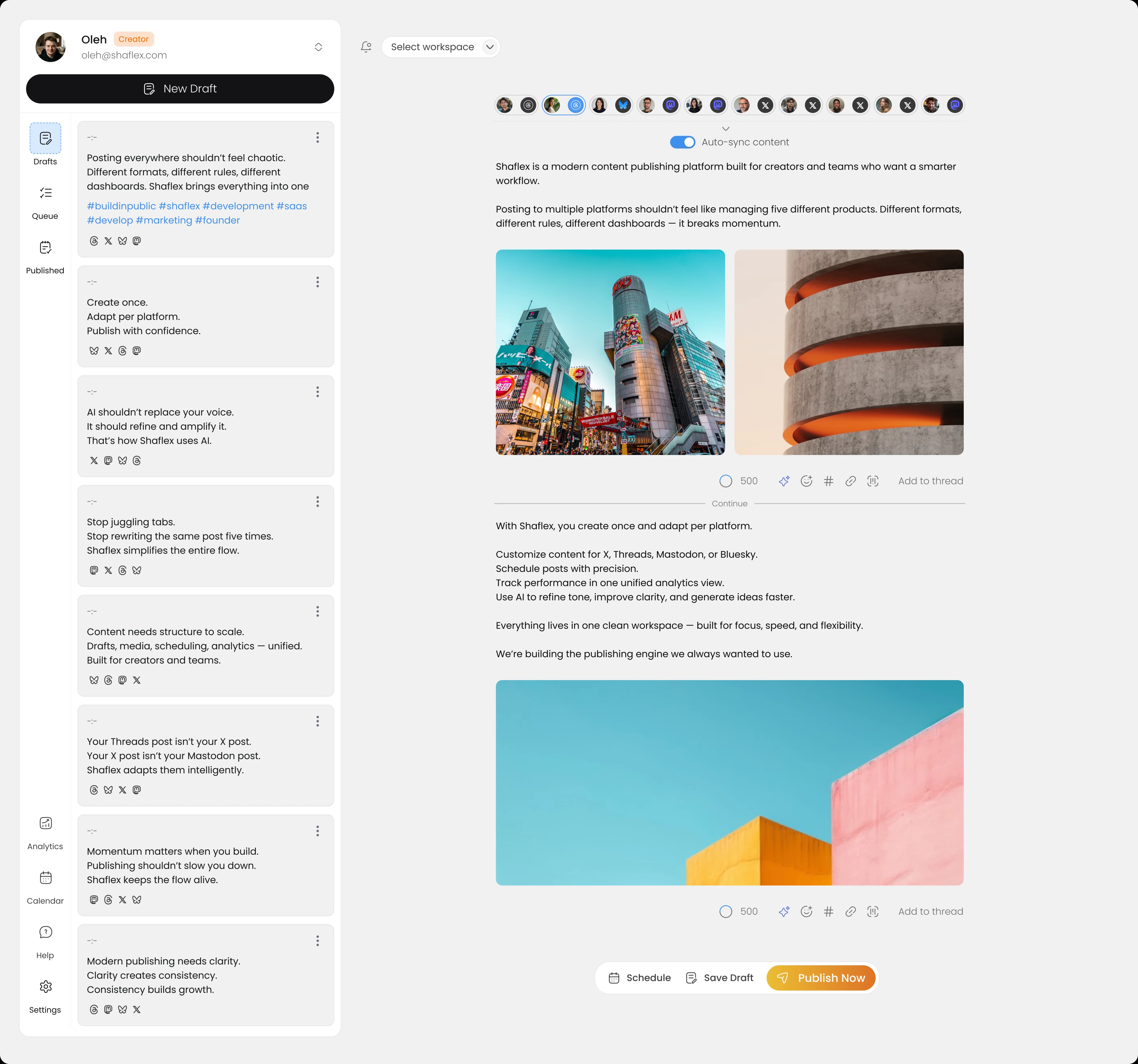
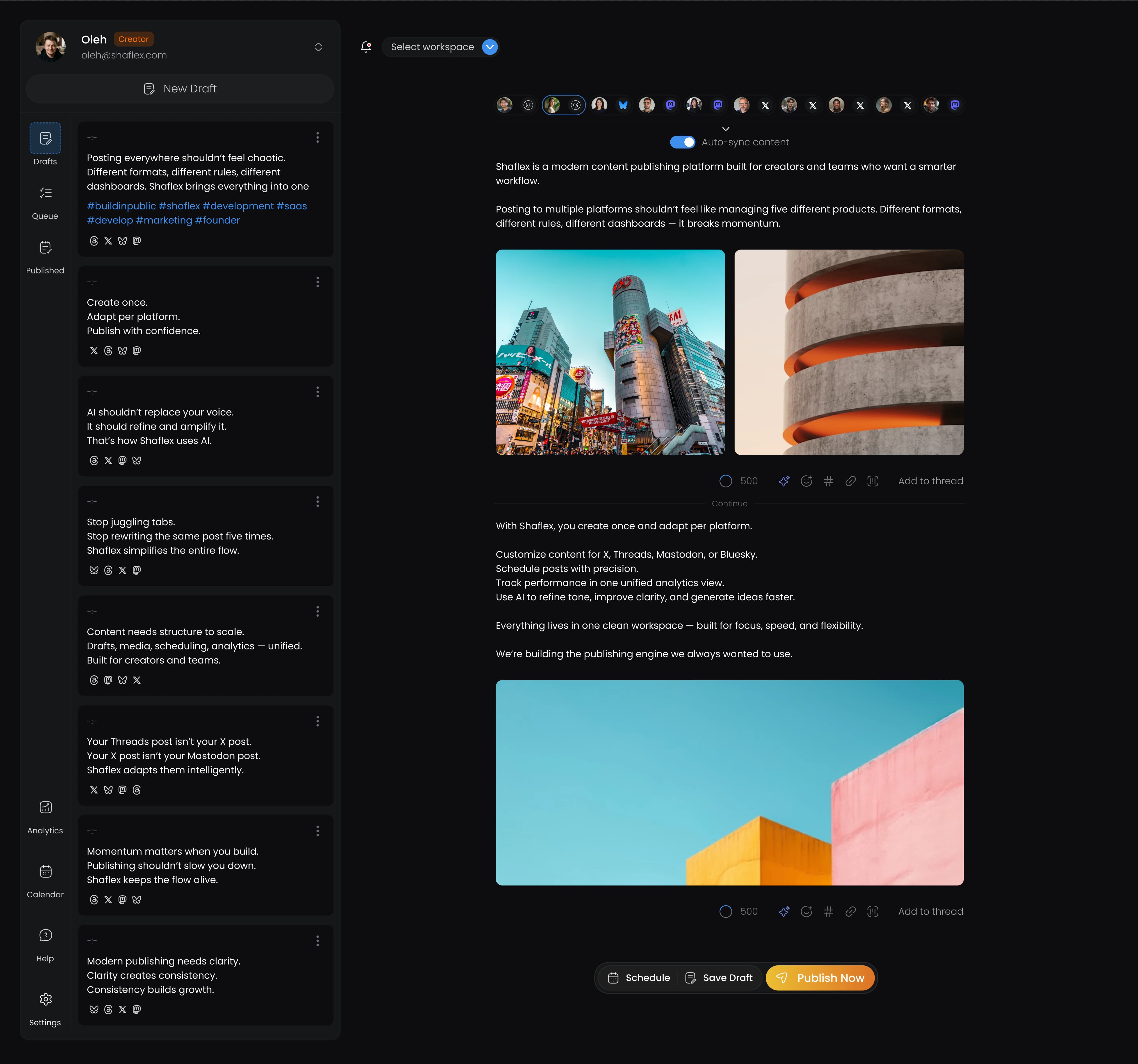
Publish to LinkedIn, Threads, Bluesky, and Mastodon from one editor. Schedule posts, track analytics, and stay consistent without switching between apps. Try Shaflex free. No credit card required.

 Apr 22, 2026