You post three times a week. You get some likes. A few new followers trickle in. But nobody can describe what you stand for, and neither can you. This is the gap between having an audience and having a brand. The missing piece is a personal brand thesis: one clear statement that tells the right people why they should pay attention to you and not the other thousand founders posting the same motivational quotes.
According to Command Your Brand, 90% of founders fail at personal branding. Not because they are bad at content creation, but because they never define what their brand actually means. They post without a thesis, without a point of view, and without a filter for what belongs on their feed and what does not.
This article will walk you through what a personal brand thesis is, why it matters more than posting frequency, and how to build yours in 30 minutes using a fill-in-the-blank exercise. If you have been posting once a day but still feel invisible, the problem is probably not volume. It is direction.
The Difference Between Having an Audience and Having a Brand
An audience watches. A brand attracts. The difference matters because audiences can disappear overnight, but a brand creates gravity that pulls the right people back even when the algorithm changes.
Think about it this way. If your account got deleted tomorrow and you started fresh, would anyone recognize your new content as yours? If the answer is no, you have an audience but not a brand. A brand is what people remember after they close the app.
A content strategist talks about the difference between "rented land" and "owned equity." Social media platforms are rented land. You do not control the algorithm, the reach, or the rules. Owned equity is the reputation, the point of view, and the trust you build in people's minds. That is yours no matter what happens to any single platform.
A personal brand thesis is the engine that builds owned equity. Without it, every post is a standalone event. With it, every post compounds on the one before it.
Here is the practical test. Look at your last 20 posts. If a stranger read them in order, would they be able to tell you what you believe, who you help, and why your perspective is different? If those 20 posts read like they came from 20 different people, you have an audience problem disguised as a reach problem.
What a Personal Brand Thesis Looks Like (3 Examples for Founders)
A personal brand thesis is not a tagline. It is not a bio. It is a one-sentence belief statement that shapes every piece of content you create. It tells you what to post, what to skip, and who you are trying to reach.
Here are three examples from real founder archetypes.
Example 1: The Technical Founder
"Every startup failure I have seen came from building the wrong thing, not building it wrong. I teach early-stage founders how to validate before they code."
This thesis gives the founder a clear filter. Every post either supports the idea that validation matters more than engineering skill, or it does not belong on the feed. It also tells the audience exactly who this person helps (early-stage founders) and what they believe (building the wrong thing is the real risk).
Example 2: The Bootstrap Advocate
"You do not need venture capital to build a profitable software company. I document how I am growing mine to $1M ARR without outside funding."
This founder now has a built-in content engine. Every revenue update, every hiring decision, every product choice gets framed through the lens of bootstrapping. The thesis repels founders who are optimizing for fundraising, and that is the point.
Example 3: The Community-First Operator
"Distribution is not a marketing problem, it is a product problem. I build products that people want to share, and I show you how."
This thesis positions the founder as someone who thinks about growth differently. It attracts product-minded founders who are tired of paid ads and growth hacks. It gives the founder permission to ignore content about ad spend optimization because it falls outside the thesis.
Notice that none of these examples mention specific platforms, tools, or tactics. A thesis operates at the belief level. The tactics come after.
The "One Sentence Test": If You Cannot Describe Your Brand in One Sentence, Your Audience Cannot Either
This is the simplest diagnostic for your personal brand strategy. Sit down and try to write one sentence that captures what you stand for. Not what you do. Not your job title. What you believe about your industry that shapes how you show up online.
If you cannot do it, your audience definitely cannot do it. And if your audience cannot describe you in one sentence, they cannot refer you. They cannot remember you. They cannot pick you out of a feed full of similar voices.
The one sentence test has three rules.
Rule 1: It must contain a belief, not a description. "I am a SaaS founder" is a description. "Most SaaS founders waste their first year building features nobody asked for" is a belief. Beliefs create tension, and tension creates attention.
Rule 2: It must exclude people. If your sentence could apply to everyone, it applies to no one. A good thesis makes some people nod and others scroll past. That is by design. You want the nodders.
Rule 3: It must be specific enough to generate content. If you read your thesis and cannot immediately think of five posts that would support it, the thesis is too vague. Go narrower.
Try it right now. Write your sentence. If it takes you more than two minutes, that delay is information. It means you have not yet decided what you stand for, and every post you write without that decision is a coin flip.
The founders who pass this test tend to have something else in common: their content sounds like them. If you want to go deeper on finding your voice, read our guide on how to sound human in the age of AI content. Authenticity and thesis work together.
How the SPCL Framework Maps to Personal Brand Thesis Building
The SPCL framework breaks down the four reasons people follow someone: Status, Power, Credibility, and Likeness. Most founders lean on one of these without realizing it. Understanding all four helps you build a thesis that works on multiple levels.
Status is about association. People follow you because being connected to you raises their perceived value. For founders, status comes from visible success. Revenue milestones, notable customers, press mentions, conference stages. Status-driven content answers the question: "Would I want other people to know I follow this person?"
Power is about access. People follow you because you give them tools, frameworks, or information they cannot easily get elsewhere. Power-driven content answers: "Will following this person make me more capable?" Most educational content falls here.
Credibility is about proof. People follow you because you have done the thing you are talking about. Credibility-driven content answers: "Has this person actually achieved what they are teaching?" This is where building in public becomes a branding strategy, not just a content format. When you share real numbers, real failures, and real decisions, you are stacking credibility.
Likeness is about identity. People follow you because they see themselves in you. Likeness-driven content answers: "Does this person understand my situation?" This is the most underrated dimension. Founders who share the specific frustrations of their niche (not generic startup advice, but the particular pain of running a two-person dev shop or bootstrapping in a crowded market) build likeness fast.
Your personal brand thesis should touch at least two of these four dimensions. Here is how to check.
Take your one sentence thesis and ask: Does this signal status? Does it offer power? Does it establish credibility? Does it create likeness? If your thesis only hits one dimension, it is fragile. A thesis that combines credibility and likeness, for example, creates both trust and connection.
Consider the bootstrap advocate example from earlier: "You do not need venture capital to build a profitable software company. I document how I am growing mine to $1M ARR without outside funding." This hits credibility (documenting real numbers), likeness (speaking to a specific type of founder), and power (showing how). That is three out of four. Strong thesis.
Map your own thesis against the SPCL framework. If it only hits one dimension, revise it. Most weak theses are all power (educational content) with no likeness (personal connection). Adding your specific situation, your constraints, or your contrarian take is usually what fixes it.
Why Speaking to Everyone Means Resonating With No One
One branding strategist, known for building cult-like personal brands, argues that the strongest brands are not built on broad appeal. They are built on a worldview that your audience adopts as their own. The goal is not to reach the most people. It is to become essential to a specific group.
This is brand positioning at its core. When you try to speak to every founder, every creator, every professional on the internet, you end up saying things that are technically true but emotionally flat. "Work hard and stay consistent." "Provide value." "Be authentic." These statements are not wrong. They are just empty. They do not give anyone a reason to follow you instead of the next person saying the same thing.
Specificity is what creates resonance. Compare "tips for growing on social media" with "how two-person SaaS teams can grow on LinkedIn without a content team." The second version makes a smaller group of people feel like you are talking directly to them. That feeling is what turns followers into fans.
There is a practical reason for this beyond emotional connection. Algorithms reward engagement rate, not total reach. A post that gets 50 comments from 500 targeted followers outperforms a post that gets 5 comments from 5,000 random followers. When you narrow your thesis, you concentrate engagement among people who actually care, and the algorithm notices.
This is also why your LinkedIn personal branding strategy should be different from your Threads or Bluesky strategy. Each platform has a different audience composition. But your thesis stays the same. What changes is the angle, the format, and the depth. The core belief remains constant across every platform.
The fear founders have is that narrowing their thesis will limit their growth. The opposite is true. Narrow theses create word-of-mouth. When someone can say "you should follow this person, they talk about X for people like us," they become your unpaid marketing team. Vague brands do not generate that sentence.
The cult-like brand approach works because it gives the audience something to belong to. Your thesis is not just your opinion. It becomes a shared belief among your followers. When a reader adopts your thesis as their own ("yeah, I agree that validation matters more than code"), they are not just following you. They are joining a perspective. That is brand equity you cannot buy with ads.
Defining Your Personal Brand Thesis in 30 Minutes: Fill-in-the-Blank Exercise
Stop reading theory. Open a document. Set a timer for 30 minutes. Work through these five steps to define your brand.
Step 1: Identify Your Audience (5 minutes)
Fill in this sentence:
"I create content for [specific group] who are struggling with [specific problem]."
Be ruthless about specificity. Not "founders." Not "tech people." Think: "Solo founders with technical backgrounds who are trying to grow their first product past $5K MRR."
If you are not sure who your audience is, look at your DMs and replies. Who is actually engaging with your content? That is your audience, whether you planned it that way or not.
Step 2: Name Your Contrarian Belief (5 minutes)
Fill in this sentence:
"Most people in my space believe [common assumption], but I believe [your contrarian take]."
Examples:
- "Most people believe you need to post every day to grow. I believe you need to post with a point, even if that means posting less."
- "Most people believe you need a big following to launch a product. I believe you need 100 true fans who trust your judgment."
- "Most people believe branding is about aesthetics. I believe branding is about having one clear argument you keep making."
Your contrarian belief is the engine of your thesis. It generates tension, and tension generates content.
Step 3: State Your Proof (5 minutes)
Fill in this sentence:
"I can speak to this because [your direct experience or credentials]."
This is where credibility enters the picture. You are not just sharing an opinion. You are sharing an opinion backed by something real. Maybe it is your revenue numbers. Maybe it is five years of doing the wrong thing before figuring out the right thing. Maybe it is clients you have helped.
Without proof, your thesis is just a hot take. With proof, it is a brand.
Step 4: Combine Into One Sentence (10 minutes)
Take your answers from steps 1 through 3 and merge them into a single sentence. This is your personal brand thesis.
Template:
"I help [audience] [achieve outcome] by [your unique approach], based on [your proof]."
Example outputs:
- "I help bootstrapped SaaS founders grow past $10K MRR without paid ads, based on three years of documenting what actually moved the needle for my own product."
- "I help first-time founders validate ideas before writing code, based on watching 40 startups in my accelerator cohort fail from the same mistake."
- "I help creators build on platforms without depending on them, based on growing my newsletter to 15K subscribers entirely from organic social."
Your thesis does not need to be permanent. It will evolve as your experience and audience grow. But you need a starting point. A draft thesis is infinitely better than no thesis.
Step 5: Stress Test It (5 minutes)
Run your thesis through these four checks.
The Content Check: Can you list 10 post ideas that directly support this thesis? If yes, it is specific enough to be useful. If no, go narrower.
The Exclusion Check: Does your thesis clearly exclude certain topics or audiences? If it could apply to anyone, it is too broad. The power of a thesis is in what it filters out.
The SPCL Check: Does it hit at least two of the four dimensions: Status, Power, Credibility, Likeness? If it only hits one, revise. Add your personal story for likeness. Add specific results for credibility.
The Referral Check: Could someone who follows you describe your thesis to a friend in one sentence? If the sentence is too complex or too generic to repeat, simplify it.
Putting Your Thesis to Work
A thesis without execution is just a journal entry. Here is how to apply it starting this week.
Audit your existing content. Go through your last 30 posts. Tag each one as "on thesis" or "off thesis." If more than half are off thesis, that explains why your audience feels scattered. You do not need to delete old posts, but you do need to shift the ratio going forward.
Create a content filter. Before you write any post, ask: "Does this support my thesis?" If the answer is no, skip it. This one question will save you hours of creating content that does not compound.
Build a thesis-first content calendar. Instead of brainstorming random topics, generate content ideas directly from your thesis. Each post should either reinforce your core belief, provide evidence for it, share a story that illustrates it, or address an objection to it. Those four angles give you an infinite content loop.
Tell your audience your thesis directly. Write a post that says "here is what I believe and why." Pin it. Link to it. Reference it in future posts. When new followers land on your profile, they should be able to understand your thesis within 30 seconds.
Repeat your thesis more than you think you should. You will get bored of saying the same thing long before your audience does. The founders with the strongest brands are the ones who make the same core argument from a hundred different angles. Repetition is not laziness. It is how brand positioning works.
What Happens When You Get This Right
When your thesis is clear, three things change.
First, your content gets easier to create. You stop staring at a blank screen wondering what to post because your thesis generates ideas for you. Every client win, every product update, every industry observation gets filtered through your thesis and becomes a post.
Second, your audience gets more valuable. Instead of random followers who liked one viral post, you attract people who share your worldview. These are the people who buy your products, join your community, refer their friends, and stick around when you change platforms.
Third, your brand becomes portable. Platform algorithms change. Features disappear. New networks launch. But your thesis travels with you because it lives in your audience's mind, not in any platform's database. That is owned equity in practice.
The founders who define their brand early have a compounding advantage. Every post builds on the one before it. Every new follower arrives pre-aligned with your worldview. Every piece of content reinforces the same message. Over six months, that compounds into something that looks like overnight success but is actually the result of saying one thing clearly and consistently.
You do not need a bigger audience. You need a clearer thesis. Define it, filter your content through it, and watch the right people start showing up.
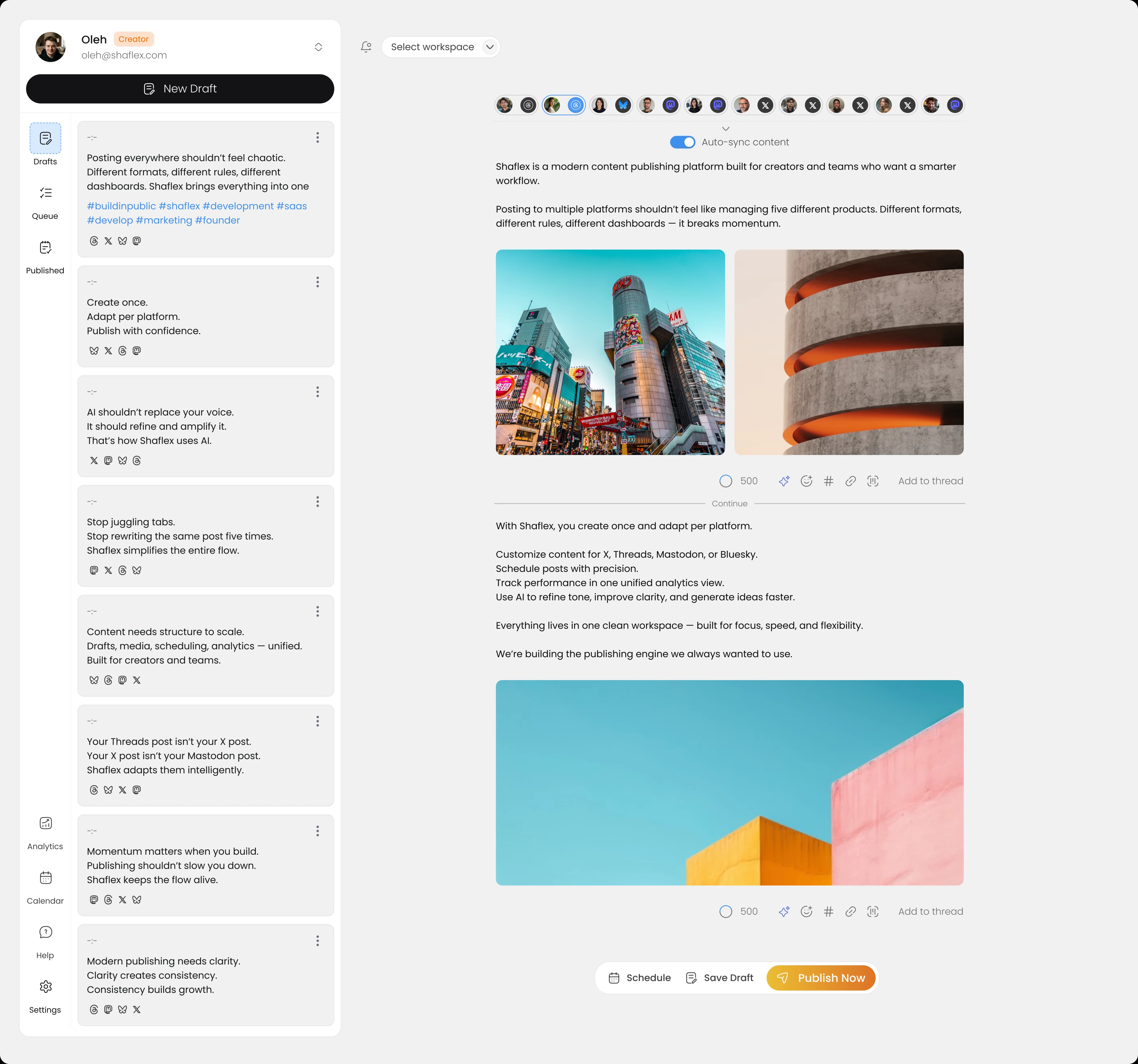
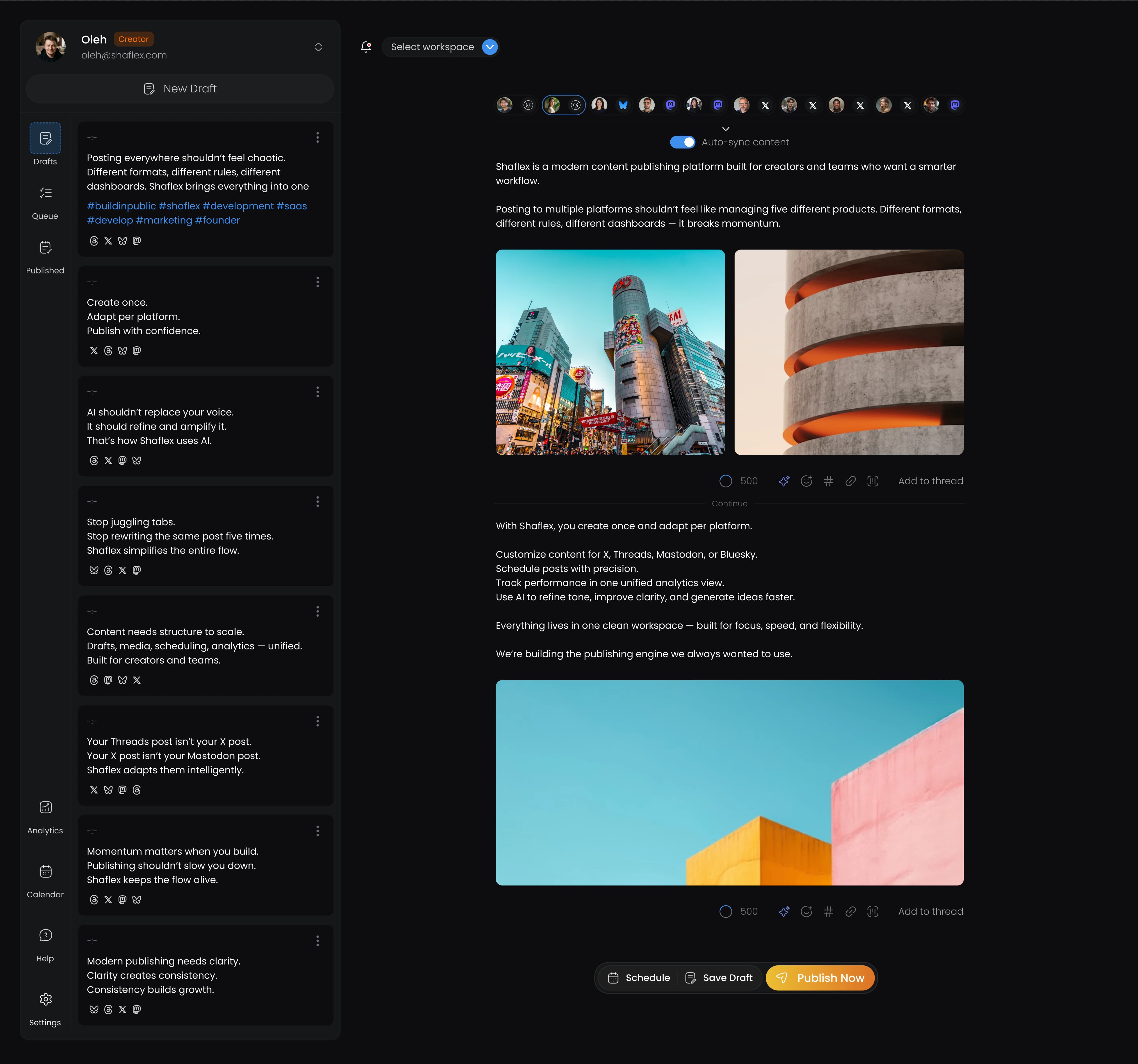
If you are ready to start executing on your thesis across multiple platforms without spending hours rewriting the same post, try Shaflex for free. Write once, adapt for every platform, schedule it, and keep showing up with a point.

 Apr 22, 2026